Hot stamping steel is the material that keeps the passenger cell of a modern car intact in a crash. It is soft enough to form like mild steel when it is hot, and after quenching in the die it becomes one of the strongest materials on the vehicle: 1,300–1,700 MPa for the classic 22MnB5 class, 1,800–2,150 MPa for the latest grades, and up to the 2,400 MPa class in hot gas forming trials.
The short answer: hot stamping steel (also called press-hardening steel, PHS, boron steel or B-steel) is a manganese–boron steel that is heated to about 930–950 °C, formed while it is fully austenitic, and quenched in a water-cooled die so that it turns into martensite. The process solves the two problems that stop cold stamping at ultra-high strength: poor formability and springback. The hard part for buyers is not the metallurgy. It is the names. The same steel family is sold as 22MnB5, Usibor® 1500P, B1500HS, HC950/1300HS or an OEM code such as CR1900T-MB or PHS950Y1300T. This guide sorts them out.
30-second primer: hot stamping steel for buyers
- Lightweighting needs strength. Thinner panels only keep crash performance if the steel is stronger. That is why carmakers moved from mild steel to AHSS, and then to press-hardened steel for the safety cage.
- Cold forming hits a wall. As cold-formed steel gets stronger, it cracks more easily and springs back more, which makes dies expensive and tryout slow.
- Hot stamping moves the strength to the end of the process. The blank is formed soft (ferrite + pearlite, about 500–700 MPa in the delivery state) and hardened in the die (martensite).
- Boron is the key element. A few parts per million of boron, typically ≤0.0050%, makes the steel hardenable enough to form martensite at the cooling rates a die can deliver.
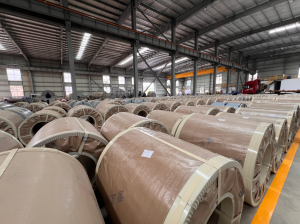
- Typical gauge range is 0.8–4.0 mm, from thin bumper reinforcements to thick door-ring and pillar sections, in cold-rolled, hot-rolled pickled and coated (AlSi or zinc-based) forms.
How hot stamping works: five steps from blank to part
| # | Step | What happens | What must be controlled |
|---|---|---|---|
| 1 | Blanking | The coil is cut into flat blanks of the developed shape | Blank contour, edge quality, coating damage at the edge |
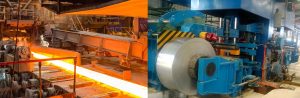
| 2 | Austenitizing | The blank is heated to 930–950 °C and soaked until fully austenitic: soft, ductile, low strength | Furnace temperature and dwell time; dew point and coating alloying for AlSi |
| 3 | Hot forming + die quenching | The blank is transferred quickly to the press, formed, and held closed while water channels in the die cool it fast enough to make martensite | Transfer time, die cooling rate, holding pressure and time |
| 4 | Laser trimming | Parts are now too hard for conventional trim dies, so holes and edges are cut by laser robots | Cut quality, cycle time, dimensional checks |
| 5 | Post-treatment (shot blasting) | Uncoated parts are shot blasted to remove the scale formed at high temperature | Only needed for uncoated steel; AlSi and zinc-based coatings avoid it |
Why it beats cold stamping at this strength level
- Ultra-high strength: finished parts routinely exceed 1,500 MPa tensile strength; advanced grades such as HC1200/1800HS reach 2,150 MPa.
- High dimensional accuracy: forming happens hot and the part is quenched under load, so springback is practically eliminated.
- Complex shapes: geometries that would crack in a cold-formed 1,500 MPa steel are formed easily in the austenitic state.
- Lightweighting: the strength lets designers reduce gauge or replace multi-piece reinforced assemblies with one part.
Chemistry: what carbon, manganese, boron and titanium do
The Baosteel enterprise standard Q/BQB 409-2023 shows clearly how the chemistry is tuned for each strength level. Two grades from that standard make a useful comparison: the classic 1,500 MPa-class HC950/1300HS and the 2,000 MPa-class HC1200/1800HS.
| Element | HC950/1300HS | HC1200/1800HS | What it does |
|---|---|---|---|
| C | 0.20–0.25% | 0.30–0.38% | Sets the hardness of the martensite. Higher carbon is the main route to 2,000 MPa. |
| Mn | 1.0–1.4% | up to 2.0% | Stabilizes austenite and supports full hardening, even in thick sections or slower-cooling areas of the die. |
| B | ≤0.0050% | ≤0.0050% | The “soul” of hot stamping steel: a tiny addition that greatly increases hardenability. |
| Ti | ≤0.05% | ≤0.05% | Ties up nitrogen to protect the boron, and refines the grain for better toughness. |
Mechanical properties after hot stamping
| Grade | Condition | Yield strength | Tensile strength | Microstructure |
|---|---|---|---|---|
| HC950/1300HS | Delivery (soft) | – | – | Ferrite + pearlite |
| HC950/1300HS | After hot stamping | 950–1,250 MPa | 1,300–1,700 MPa | Martensite |
| HC1200/1800HS | After hot stamping | 1,200–1,500 MPa | 1,800–2,150 MPa | Martensite |
Note the naming logic: in HC950/1300HS, 950 is the minimum yield strength and 1300 the minimum tensile strength after hot stamping, both in MPa; HS stands for hot stamping. MOOPEC supplies the full Baosteel hot-stamping series, from HC340/460HS to HC1200/1800HS. See the HC950/1300HS and HC1200/1800HS grade page for available specifications.
Hot stamping steel grades: European, mill and OEM names
There is no single global grade name for press-hardening steel. Every mill and almost every carmaker has its own system. The table below groups the most common names so you can see which family a drawing is calling for.
| Naming system | Typical grades | How to read it |
|---|---|---|
| European / chemistry-based | 20MnB5, 22MnB5, 34MnB5 | Carbon content × 100 (0.20%, 0.22%, 0.34% C), plus Mn and B. 22MnB5 is the benchmark 1,500 MPa-class grade; 34MnB5 is a higher-carbon, higher-strength option. |
| ArcelorMittal | Usibor® 1500P (AlSi coated), Usibor® 2000 | Mill brand name + tensile strength class after hot stamping. |
| Baosteel | B1500HS; HC950/1300HS, HC1200/1800HS (Q/BQB 409-2023) | B = boron; 1500 = tensile class; HS = hot stamping. HC grades state minimum yield / minimum tensile strength. |
| Volkswagen | CR1900T-MB-DS-UC | CR = cold rolled; 1900T = tensile strength class; MB = manganese–boron; suffixes define surface and coating. |
| Mazda | CMA2000HS | 2,000 MPa-class hot-stamping material. |
| Ford | CRRA1200 | Ford material code for press-hardening steel. |
| GAC | GHF1500L | 1,500 MPa-class hot-forming material. |
| NIO | PHS950Y1300T | PHS = press-hardening steel; 950Y = yield, 1300T = tensile (MPa). Same property window as HC950/1300HS. |
| Toyota | SCHS20B | Toyota hot-stamping steel code. |
| BMW | CR300MB | BMW cold-rolled manganese–boron material code. |
A practical rule: do not cross-reference grades by name. Cross-reference by chemistry, delivery-state properties, post-quench yield and tensile windows, coating type and coating weight, then let the supplier confirm the equivalent against the OEM specification. Two grades with “1500” in the name can still differ in coating, carbon range and bendability.
Strength tiers at a glance
| Tensile class after quenching | Typical grades | Where it is used |
|---|---|---|
| 1,300–1,700 MPa | 22MnB5, 20MnB5, Usibor® 1500P, B1500HS, HC950/1300HS, PHS950Y1300T, GHF1500L | Most hot-stamped safety-cage parts |
| 1,800–2,150 MPa | 34MnB5, HC1200/1800HS, CR1900T-MB, CMA2000HS, Usibor® 2000 | Parts where gauge reduction or intrusion resistance is critical |
| 2,200–2,400 MPa class | Zinc-based hot-forming steel for hot gas forming | Tubular A-pillars, B-pillars, door beams (see below) |
Where hot stamping steel goes on the car
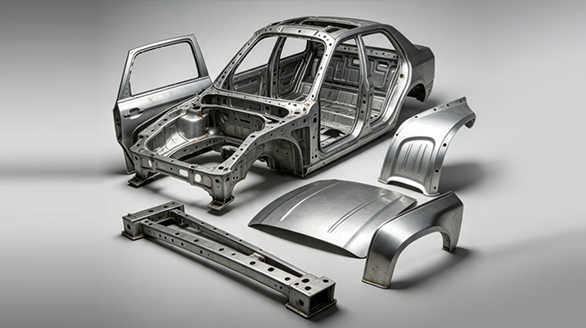
Press-hardened parts form the anti-intrusion skeleton of the body-in-white: A-pillars, B-pillars, C-pillars, roof side rails, rocker (sill) reinforcements, the central tunnel, floor cross members and the dash panel / front bulkhead. In a crash, these parts are meant to stay intact so the passenger compartment keeps its shape.
Coatings: uncoated, AlSi and zinc-based
| Product form | Advantages | Limitations |
|---|---|---|
| Uncoated (cold rolled, hot rolled pickled) | Lowest material cost; widest gauge range | Scale and decarburization in the furnace; needs shot blasting or a protective atmosphere |
| Hot-dip aluminum–silicon (AS), about 5–11% Si, balance Al | No scale or decarburized layer; no shot blasting; high dimensional accuracy; good corrosion resistance | Furnace process window must be controlled; surface quality can be harder to control in some processes |
| Zinc-based (e.g. Baosteel BaoGZ®) | Strong corrosion protection after painting | Conventional galvanized steel has a low zinc melting point and can oxidize during heating; needs a dedicated coating design |
Advanced technology: hot gas forming of hot stamping steel tubes
Hot stamping is no longer only about flat blanks. Hot gas forming (also called hot metal gas forming) is attracting attention, especially from EV makers who want a lighter and stronger body. A hot stamping steel tube is heated, placed in a die, and expanded with high-pressure gas, much like blowing up a balloon, until it fills the die cavity. It is then quenched in the die.
Why carmakers are interested
- Variable cross-sections: one closed tube can change shape and size along its length, which gives designers more freedom than welded flanged sections.
- Ultra-high strength: better crash performance and more weight saving.
- High dimensional accuracy: better fit in the assembly and easier welding to the rest of the body.
- Typical parts: A-pillars, B-pillars, door impact beams and the shotgun (the extension of the front longitudinal rail): parts that need high strength and complex shapes.
Why the steel is the bottleneck
The process chain is complex, and each conventional material option has a weakness:
- Uncoated tube: oxidizes and decarburizes during heating, and the inside of a closed tube is very hard to shot blast.
- AlSi-coated tube: surface quality is difficult to control in this process.
- Conventional galvanized tube: zinc melts at a low temperature and oxidizes during heating, which damages the coating.
That is why the industry is developing zinc-based hot forming steels designed specifically for hot gas forming. The newest of these already reach 2,200 MPa-class strength in production parts, and the 2,400 MPa class has been validated in small batches, while keeping corrosion resistance, formability and accuracy.
Coming next: our next article is a full review of Baosteel BaoGZ®, the zinc-based hot forming steel developed for hot gas forming. It covers the surface design, the coating behaviour during heating, the 2,200 MPa production parts and the 2,400 MPa trials. Follow the MOOPEC blog so you don’t miss it, or tell us about your project and we will send you the technical summary as soon as it is out.
What to put in your RFQ for hot stamping steel
An enquiry that says only “22MnB5, 1.5 mm” will be quoted, but often for the wrong product. This is the version that gets an accurate quote the first time.
| Parameter | What to write | Why it matters |
|---|---|---|
| Grade + standard | The grade and the standard or OEM specification it comes from, e.g. HC950/1300HS (Q/BQB 409) or CR1900T-MB (OEM spec) | Names do not translate 1:1 between systems |
| Post-quench properties | Required yield and tensile window after hot stamping; bendability if specified | This is what the part is validated on |
| Substrate | Cold rolled, hot rolled pickled, or tube | Sets the gauge range and the process route |
| Coating | Uncoated, AlSi (with coating weight), or zinc-based | Decides whether you need shot blasting and protective atmosphere |
| Thickness + tolerance | e.g. 1.2 mm ±0.05 mm, within the 0.8–4.0 mm range | Affects heating time and quench rate |
| Form | Coil, slit coil, sheet, or developed blank | Blanks save a processing step at your plant |
| Documents | EN 10204 3.1 / 3.2 certificate, OEM approval status if required | Required for PPAP and OEM audits |
FAQ
What is the difference between 22MnB5 and Usibor® 1500P?
22MnB5 is a chemistry-based steel name. Usibor® 1500P is ArcelorMittal’s brand of a 22MnB5-type steel with an aluminum–silicon coating. Both reach about 1,500 MPa after hot stamping, but the coating changes how the blank is heated and whether the part needs shot blasting.
Is B1500HS the same as HC950/1300HS?
Both are Baosteel 1,500 MPa-class hot stamping steels. HC950/1300HS is the designation in the Q/BQB 409-2023 enterprise standard, which states minimum yield and tensile strength after hot stamping. Always check the standard and coating your drawing calls for.
What is the strongest hot stamping steel available?
For flat-blank hot stamping, grades such as HC1200/1800HS reach a tensile strength of 1,800–2,150 MPa. For hot gas formed tubes, zinc-based hot forming steel reaches the 2,200 MPa class in production parts, and the 2,400 MPa class has been validated in small batches.
The last word: system safety, not just the strongest steel
Hot stamping steel gives a single part extraordinary strength, but vehicle safety is a property of the whole body, not of one material. Crumple zones need controlled deformation to absorb energy; the passenger cell needs high-strength support. The right answer is to match each area of the body with the material whose behaviour fits its job in a crash. New materials and new processes, such as zinc-based steel for hot gas forming, are valuable because they give engineers more options for that match.
MOOPEC is a Shanghai-based metal supply and deep-processing specialist supplying automotive steel, electrical steel and aluminum to global OEM and Tier-1 buyers. Looking for a hot stamping steel grade to match an OEM specification? Send MOOPEC your drawing and material spec, and we will map it to the mill grade and quote the trial batch and the production route side by side.