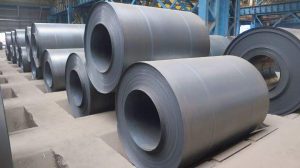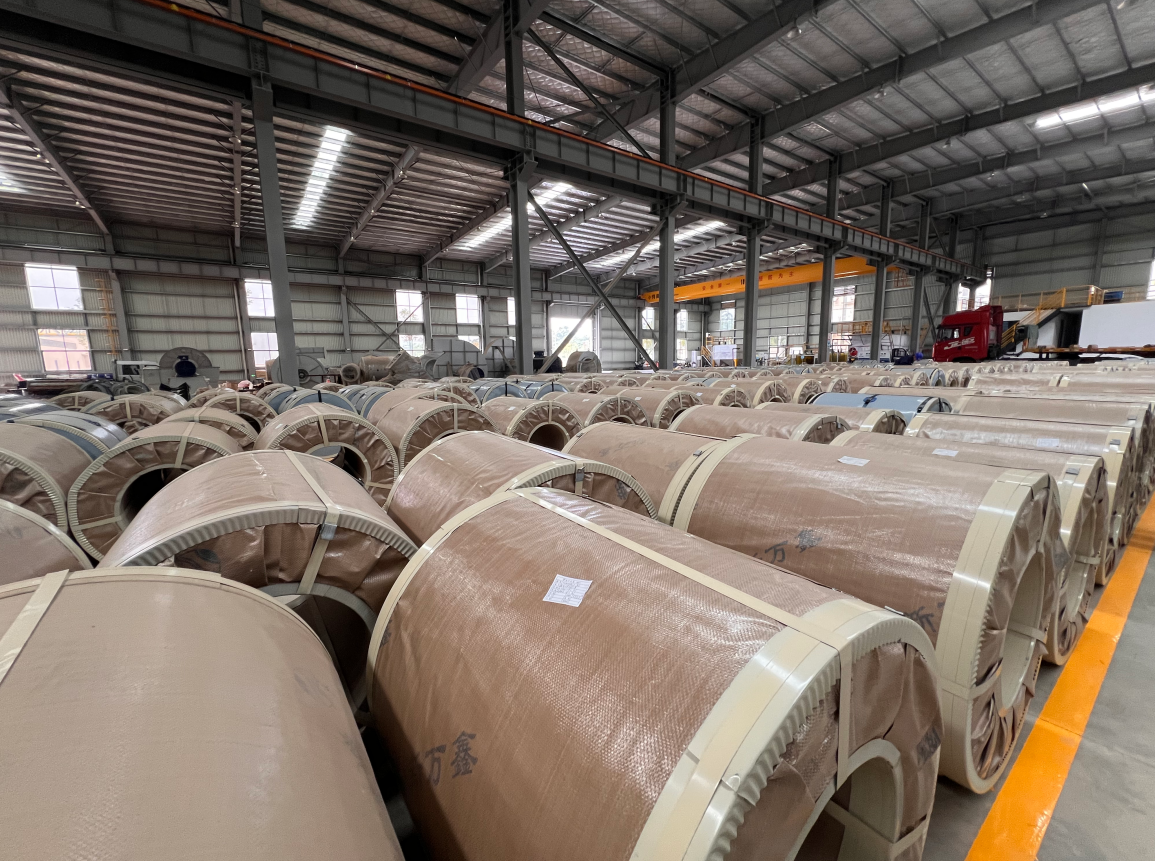
Deep processing is the set of steps that turns a mill-produced electrical steel coil into finished laminations ready for core assembly. Every cutting and heat step changes the magnetic performance of the steel — which is why the grade you buy and the way it is processed are two separate decisions that must be specified together.
The short answer: deep processing is everything that happens to electrical steel after the mill makes it and before the core builder stacks it. It has seven steps: incoming inspection, slitting, cut-to-length, shaping and mitring, deburring, stress-relief annealing, and stacking. The reason it deserves your attention as a buyer is simple — cutting and heat change the magnetic properties of the steel. A premium grade that is slit badly can perform worse than a standard grade that is slit well. The grade certificate tells you what left the mill. It does not tell you what arrives at your core line.
30-second primer: electrical steel for buyers who do not know metallurgy
- Electrical steel is a special steel whose crystal grains are lined up so magnetism flows easily in one direction. CRGO means cold-rolled grain-oriented: the grains point along the rolling direction.
- It is rolled thin — commonly 0.23 mm, 0.27 mm or 0.30 mm — and coated with a thin insulating layer so stacked sheets do not conduct electricity into each other.
- Those coated sheets are cut and stacked to make a transformer core, the magnetic circuit inside every transformer.
- The core is magnetized whenever the transformer is switched on, even with nothing plugged in. That always-on loss is no-load loss (also called core loss or iron loss), measured in watts per kilogram (W/kg).
- Lower W/kg means a cooler, more efficient transformer — and a more expensive steel.
That is the whole subject in five lines. Everything below is about protecting that number through processing.
The seven steps, and what each one controls
| # | Step | What happens | What must be controlled | What goes wrong if it is not |
| 1 | Incoming inspection | Coil is checked against the mill certificate before it is cut | Thickness, width, coating continuity, surface condition, MTC (EN 10204 3.1 / 3.2) | A scratch, rust spot or coating break discovered after cutting has already cost you the coil |
| 2 | Slitting | Wide coil is cut lengthwise into narrow strips on a rotary shear line | Blade clearance and condition, strip width tolerance, camber, burr height | Burr bridges the insulation between sheets and creates circulating currents |
| 3 | Cut-to-length | Strips are sheared into individual lamination lengths | Length tolerance, squareness, edge condition | Stack height drifts, gaps open at the joints, flux leaks |
| 4 | Shaping / mitring | Notching, V-cutting and mitring for step-lap joints | Angle accuracy, cut-edge quality at the joint | Joint loss rises; step-lap loses most of its advantage |
| 5 | Deburring | Edge conditioning to remove or reduce burr | Method (mechanical / skiving), residual edge damage | Deburring that smears metal instead of removing it makes things worse, not better |
| 6 | Stress-relief annealing | Controlled heat in a protective atmosphere to relax cutting stress | Peak temperature, soak time, atmosphere, coating temperature limit | Wrong cycle destroys the coating or warps the laminations |
| 7 | Stacking and packing | Laminations are collated into sets and packed for shipment | Stacking factor, set integrity, edge protection, corrosion protection | A perfect stack arrives damaged and has to be re-sorted by hand |
Why processing can quietly undo a good grade
There are three mechanisms, and they all point the same way: mechanical damage and stress increase iron loss.
Burr creates electrical bridges. When a slitting blade is worn or the clearance is wrong, the cut edge is not clean — it rolls over into a thin fin of metal. When laminations are stacked under pressure, those fins can pierce the insulation coating and touch the neighbouring sheet. That closes a loop, current circulates in it, and the energy turns into heat instead of useful magnetic work. The loss does not show up on the mill certificate, because the mill never cut the steel.
Cutting introduces stress near the edge. The shear does not just separate the metal; it plastically deforms a narrow band along the cut. That deformed band has worse magnetic properties than the bulk material. The thinner the lamination, the more cut edges you have per unit of core volume — so thin, high-grade material is more sensitive to cut quality, not less.
Heat can repair the stress — or destroy the coating. Stress-relief annealing relaxes the deformed zone and recovers part of the lost performance. But the cycle runs at temperatures that many organic-containing coatings cannot survive. Before you specify annealing, confirm the coating class with the steel producer. High-temperature inorganic coatings can generally take a full stress-relief cycle; organic-containing coatings generally cannot. Getting this backwards is one of the most expensive mistakes in the process — and it is entirely avoidable with one question asked early.
A useful way to think about it: the grade sets the ceiling. Processing decides how much of that ceiling you actually keep.
The downstream view: what each step means for the transformer builder
If you are buying processed material rather than running your own line, these are the four things your core builder will notice first:
- Width tolerance and camber. A strip that is consistently off-width, or that curves, will not sit true in the stack. The stack is clamped; a curved strip opens gaps at the joints.
- Burr height. This is the single most-quoted number in laminated core quality, because it feeds directly into interlaminar short circuits.
- Stacking factor (space factor). This is the ratio of actual steel volume to the geometric volume of the stack — typically in the 0.95–0.98 range for grain-oriented material. It is affected by coating thickness, flatness and burr. If the stacking factor drops, the effective cross-section drops, the flux density rises for the same design, and the transformer runs hotter than calculated.
- Set integrity. Laminations delivered as collated, labelled sets per core layer remove a sorting step. Delivered loose, they create one.
What to specify in your RFQ (the checklist)
Do not send an enquiry that says only “CRGO, 0.23 mm, 500 kg”. It will be quoted, and it will be quoted wrong. Here is the version that gets quoted right the first time.
| Parameter | What to write | Why it matters |
| Grade, by measured value | Maximum core loss in W/kg at a stated test condition (e.g. ≤0.90 W/kg at 1.7 T / 50 Hz), plus thickness | Do not translate grade names across standards — translate the measured value and let the supplier map it to their equivalent |
| Thickness | 0.23 / 0.27 / 0.30 mm, with tolerance | Sets both loss and the number of cut edges per core |
| Coating class | Coating type and whether it must survive annealing | Determines whether step 6 is even available to you |
| Slit width + tolerance | Target width and tolerance (commonly ±0.10 mm; tighter is possible at higher cost) | Feeds stacking accuracy |
| Camber limit | e.g. maximum deviation over a stated length | Curved strip opens joint gaps |
| Burr limit | Maximum burr height in mm | Directly limits interlaminar short circuits |
| Length + tolerance | Cut length and tolerance (commonly ±0.2 mm to ±0.5 mm depending on the builder) | Controls stack height |
| Mitre / notching | Angle, and whether you need step-lap sets | Step-lap mitred joints measurably reduce joint loss versus a plain butt joint |
| Annealing required? | Yes / no, and the approved cycle if known | Changes coating selection and lead time |
| Stacking factor target | Minimum acceptable value | Protects the thermal design |
| Packing | Edge protection, corrosion protection, coil ID support, export crate spec | Most transit damage happens here |
| Documents | EN 10204 3.1 or 3.2, plus the processor’s own inspection report | The mill certificate covers the coil. It does not cover what happened after |
When deep processing is not the right answer
Being clear about this is part of buying well:
- If your core plant already has idle slitting capacity, buying full-width mill coil is usually cheaper. Paying someone else to slit is a capacity decision, not a quality decision.
- If you are on a standard grade with loose loss limits, ultra-tight burr and width tolerances cost money and buy you nothing measurable. Spend the tolerance budget where the design is sensitive.
- If you need annealing but specified an organic-containing coating, the fix is to change the coating — not to push the anneal harder.
- If your volume is small, custom slit widths carry setup cost. Standard widths plus in-house cutting may be the better economics.
- If lead time, not loss, is your binding constraint, choose the grade that is actually available. Waiting months for a marginally better grade usually costs more than the energy saved.
The grade certificate tells you what left the mill. It does not tell you what arrives at your core line. That gap is not closed by buying a better grade — it is closed by controlling the seven steps above, and by measuring the result instead of assuming it.
MOOPEC is a Shanghai-based metal deep-processing specialist supplying slit, cut-to-length and finished electrical steel and aluminum components to global transformer, motor and industrial buyers.
Wondering what your current laminations are actually losing? Send MOOPEC one drawing and one loss target. We will tell you what we would measure, and quote the small-batch route alongside the production route — so you can compare before you commit.