
The World’s First 3D Wound Core Transformer (1883)
Swedish engineer Jonas Wenström first invented the three-dimensional wound core transformer in 1883. That same year, he installed one at a paper mill. Today, visitors can see that unit at the Swedish Royal Institute of Technology Museum. Elektriska, a company founded in 1883, originally manufactured and sold the transformer. Later, in 1890, Elektriska merged with Granström to form ASEA.
Early Development in China (1995–2004)
Chinese companies began filing and winning patents on three-dimensional wound core transformers in 1995. By 1999, domestic manufacturers had started research and development on this technology. Meanwhile, commercial sales followed in 2002. However, few manufacturers adopted it at the time.
Haihong’s Breakthroughs (2004–2021)
In 2004, Guangdong Haihong Transformer Co., Ltd. began developing the fundamental principles, production processes, and specialized tooling for three-dimensional wound core transformers. This work, in turn, enabled the transition to mass production. In 2006, the company successfully developed the S13 oil-immersed 3D wound core transformer. Two years later, it launched the open-type dry-type version, and in 2009 it added the resin-insulated model. In 2012, the company also introduced a version utilizing amorphous metal. By 2015, the company had developed the world’s first 110kV oil-immersed 3D wound core power transformer and connected it to the grid. Finally, in 2021, it deployed a 35kV 3300kVA amorphous metal open-type dry transformer in an urban rail transit system.
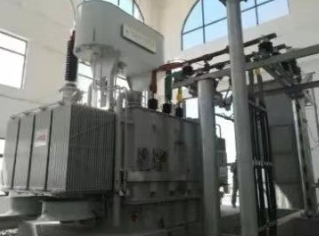
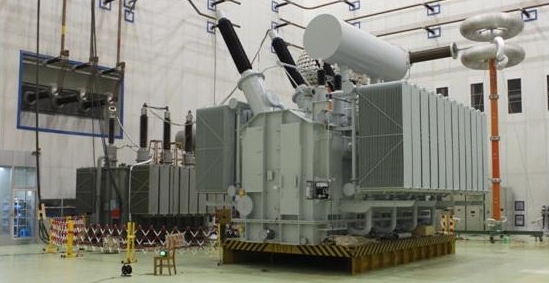
The first one is 31500kVA 110kV
Amorphous alloy three-dimensional wound core dry-type transformer
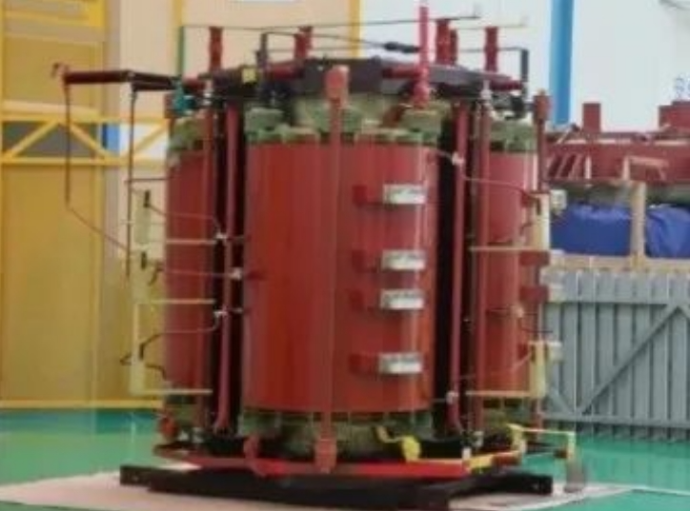
The first one is 3300kVA 35kV
Amorphous alloy three-dimensional wound core dry-type transformer
From Niche to Mainstream (2007 to Today)
By 2007, over 100 manufacturers had partnered with Haihong to promote 3D wound core technology, which significantly expanded the market. Today, this technology has matured in China. Major producers include Haihong Electric, Hebei Gaojing, Jiangxi Dazhu, TBEA Xinjiang, Jiangsu Guangte, Yantai Dongfang Electronics, and Shijiazhuang Tiantai Electric Power. In fact, industry experts consider China’s production technology in this field world-leading. Countries such as the U.S., Germany, Turkey, and several Southeast Asian nations are now attempting to license and adopt this Chinese innovation. Haihong has licensed the technology to manufacturers in the U.S., Germany, Turkey, and India for local production and distribution.
National Recognition and Application Growth
In recent years, China’s “14th Five-Year Plan” has highlighted 3D wound core transformers for industrial energy efficiency. Several national recommendation lists also feature them, including the Ministry of Industry and Information Technology’s “Energy Efficiency Star Product Directory” and the National Development and Reform Commission’s “Key Products and Services for Strategic Emerging Industries.”
Because three-dimensional wound cores save energy and material and deliver reliable, environmentally friendly performance, they represent a major trend in the evolution of transformer technology. They have seen rapid growth across sectors such as power grids, renewable energy, rectifiers, rail transit, and furnace reactors.
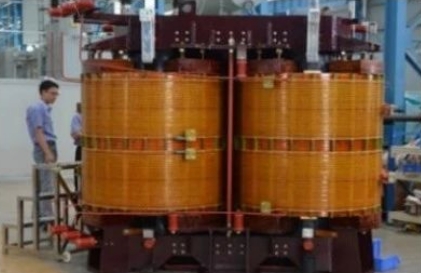
12,500 KVA open-type three-dimensional wound core dry-type transformer Applied in the field of wind power generation
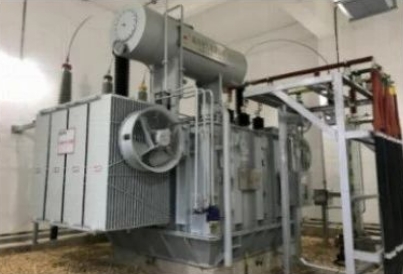
The 110kV three-dimensional wound core oil immersion power transformer is applied in the field of waste incineration power generation
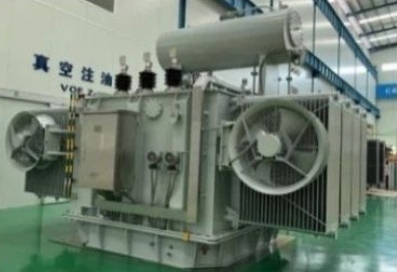
The 30,000 KVA three-dimensional wound core oil immersion rectifier transformer is applied in the papermaking field
Manufacturing Process of 3D Wound Cores
Process Flow: 3D Wound Core vs. Laminated Core
Unlike conventional laminated cores, the 3D wound core uses a winding process. The diagrams below illustrate the process flow of oil-immersed transformers with 3D wound cores versus traditional laminated cores.
A. 3D Wound Core Oil-Immersed Transformer Process Flow
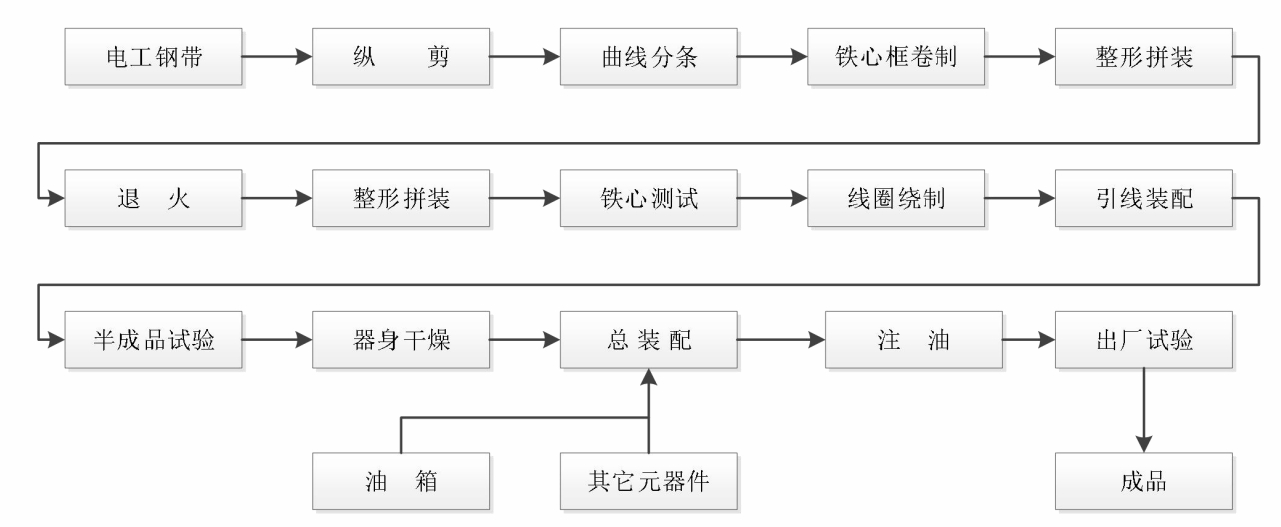
The process flow of three-dimensional wound core oil-immersed transformer
Contact us if you would like the table information.
B. Laminated Core Oil-Immersed Transformer Process Flow
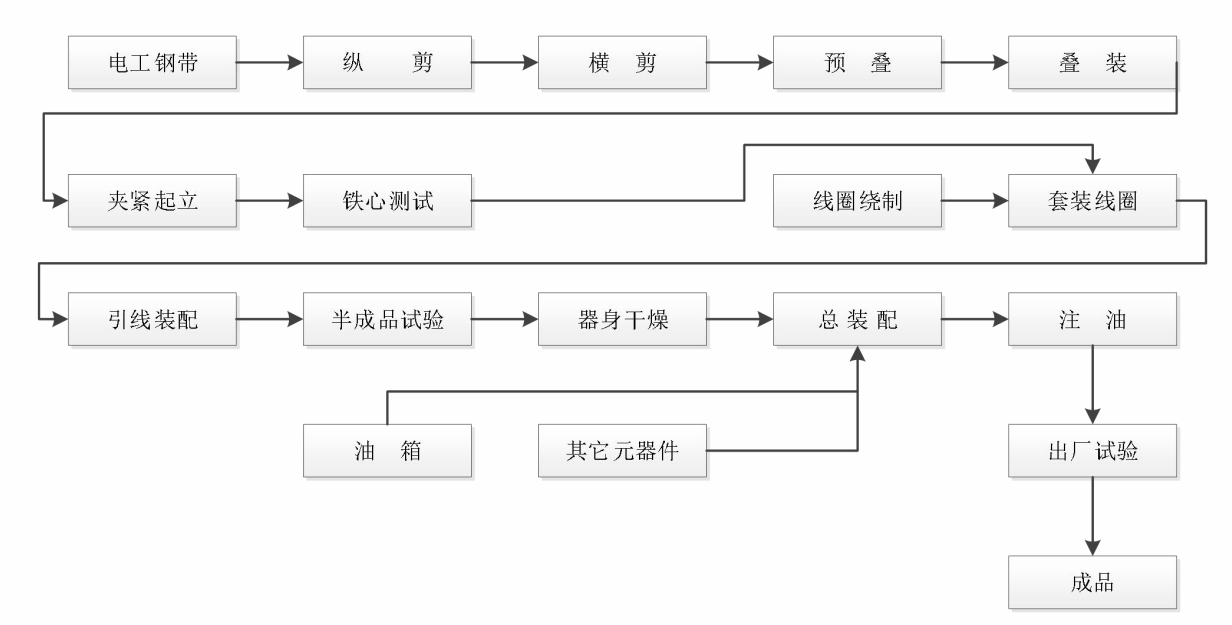
Process flow of laminated core oil-immersed transformer
Please contact us to obtain the table information.
C. Comparison of the Two Processes
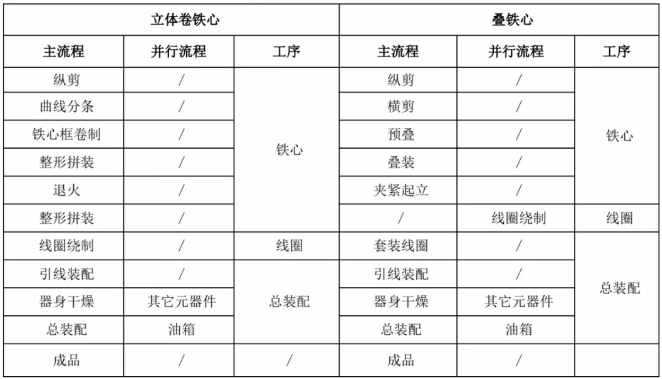
Comparison of the production processes of three-dimensional wound cores and laminated cores ▼
Contact us for the full table data.
While the core manufacturing steps differ significantly, overall labor time and manpower costs remain quite similar. For new investments, however, the 3D wound core process offers clear advantages in automation, ease of manufacturing, and process consistency.
Key Process Analysis
The most significant difference lies in the core fabrication: winding frames versus stacking laminations. Because electrical steel undergoes different treatments in each method, the entire process flow differs substantially.
Curved Slitting
Purpose: To ensure the cross-section of the wound frame is as close to circular as possible.
If the frame’s cross-section is circular, the strip width must follow a curved profile. If the frame forms a polygonal approximation, the strip width follows a slanted line. Most industry players favor the nearly circular option, because it balances material efficiency and ease of manufacturing.
This process enhances the core’s space utilization rate (filling factor) to 97.5–98.5%. As a result, it reduces overall diameter and thus minimizes material usage for both the core and the winding.
Winding Process
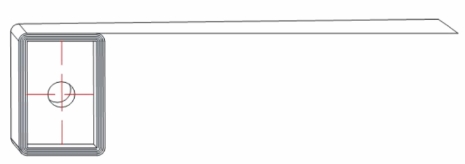 Illustration of the iron core frame rolling
Purpose: To wind the slitted strips into three identical core frames that assemble into a triangular 3D core structure. In short, this is the most critical step and the main differentiator from the laminated core process.
Advantages of this process include:
No Transverse Air Gaps Perpendicular to the Magnetic Path
Greatly reduced magnetizing current: In laminated cores, air gaps at the yoke-to-leg transition cause high magnetic reluctance. Even with multi-step slanted joints, heavy losses still consume the magnetizing current here. In contrast, 3D wound cores eliminate such transverse gaps, so the excitation current drops significantly.
Lower noise levels: Air gaps distort magnetic flux, which leads to local saturation and magnetostriction. The mechanical discontinuity also causes additional vibration and friction noise. In contrast, 3D cores avoid these issues entirely.
Reduced no-load losses: Again, distortion and local saturation increase iron loss. The 3D core avoids this effect because of its continuous magnetic path.
Magnetic Flux Follows Steel’s Grain-Oriented (100) Direction
Lower no-load losses and current: Grain-oriented electrical steel offers optimal permeability along the rolling direction. Manufacturers slit and wind 3D cores along this grain, so magnetic lines flow entirely along the material’s easy-magnetization axis. In laminated cores, magnetic flux has to bend at corners, which misaligns it with the steel grain by up to 45°. As a result, this increases losses and requires a higher magnetizing force.
Reduced noise: Better alignment also minimizes magnetostriction, which reduces vibration-induced noise.
Significant Stress at Core Corners
In laminated cores, good process control keeps stresses low, adding only 2–5% extra loss. However, the corners of wound cores experience intense deformation during winding, which introduces stress-related losses of over 60%, sometimes exceeding 100%. Therefore, stress-relief annealing becomes a critical step after winding.
Annealing Process
Purpose: To eliminate the stress introduced during winding and restore the magnetic properties of the electrical steel.
How These Key Steps Affect Performance and Material Usage
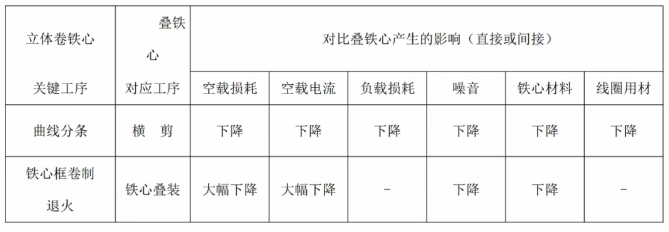 The influence of key processes of three-dimensional wound core on the product ▼
Contact us if you need the full table data.



