A transformer core RFQ gets a usable quote when it tells the supplier exactly what is being built, from which steel, how it will be tested and how it will be accepted. In practice that means a dimensioned drawing, the core construction, the steel grade and standard, the operating conditions, the acceptance criteria with a named test method, and packaging requirements. This checklist walks through each item and ends with a table you can copy into your next enquiry.
Be clear about what you are buying
Many enquiries stall because the scope is ambiguous. Transformer supply chains have four distinct stages, and each one is quoted, tested and documented differently:
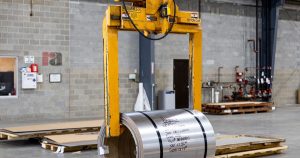
- Raw material: CRGO master coils or slit coils, supplied with a mill test certificate.
- Processed laminations: slit, cut-to-length, mitred or punched pieces, supplied loose or in stacks.
- Assembled core: laminations stacked or wound into a finished core, ready for winding.
- Finished transformer: core, windings, tank and accessories, tested as a complete unit.
State which of these you need in the first line of the RFQ. A supplier quoting laminations will not include stacking, clamping or core testing unless you ask for it, and a core supplier is not responsible for the losses of the finished transformer. If you are buying the steel itself, our CRGO purchasing checklist covers the coil-level details.

Drawings and core construction
A drawing is the single most useful document in a transformer core RFQ. It should show overall dimensions, window size, leg and yoke widths, stack height or build, step profile for round-leg cores, tolerances and any holes, slots or bolt positions. Mark which dimensions are critical so the supplier knows where tolerances matter most.
Name the construction, because it changes tooling, scrap and price:
| Construction | Typical use | What to specify |
|---|---|---|
| Stacked, mitred joints (often step-lap) | Distribution and power transformers | Mitre angle, step-lap pattern and number of steps, overlap, number of laminations per step |
| Stacked, butt-lap joints | Smaller or special designs | Joint arrangement, overlap length, stacking sequence |
| Wound core | Distribution transformers, often single-phase | Strip width, inner window, build-up, whether the core is cut and annealed |
| EI or other punched shapes | Small transformers and reactors | Lamination drawing, burr limit, stacking method |
If you only have a design concept, say so. A supplier can propose a construction, but the electrical design remains the responsibility of the transformer designer. You can send files through our technical drawing upload page.
Steel grade, standard and thickness
Specify the grade designation together with the standard it comes from, for example a grade under IEC 60404-8-7 (grain-oriented electrical steel) or the equivalent national standard you work to. Add the nominal thickness, the insulation coating requirement and whether domain-refined material is acceptable or required.
Do not write a grade and add “or equivalent”. Grades from different standards and mills are not interchangeable by name, even when their nominal loss values look similar. Any substitution should go through engineering review and, where relevant, your customer approval. If you are open to alternatives, ask the supplier to list them separately with full data so you can evaluate them.
Operating conditions the supplier needs
Core processing choices depend on how the core will run. Give at least:
- Rated frequency (50 Hz, 60 Hz or both).
- Design flux density in the core, in tesla.
- Phase arrangement (single-phase, three-phase three-leg, five-leg).
- Rating and voltage class, if you can share them, for context only.
- Any noise or loss targets the core design must support, and who owns them.
These details let the supplier check whether cutting, stacking and annealing practices fit your design. They do not transfer design responsibility to the supplier.
Acceptance criteria and test method
This is where most disputes start. Steel certificate values are measured on prepared samples under standard conditions, for example by Epstein frame (IEC 60404-2) or single sheet tester (IEC 60404-3). An assembled core will show higher specific loss than the sheet values because of joints, cutting stresses, burrs, clamping pressure and flux distribution. Certificate values therefore do not guarantee assembled-core performance.
Agree up front which of these you will use to accept the goods:
| Acceptance level | Typical evidence | Notes |
|---|---|---|
| Material | Mill test certificate (often to EN 10204 type 3.1) | Confirms the steel, not the core |
| Dimensional | Inspection report against the drawing | Define sampling and critical dimensions |
| Lamination quality | Burr height, flatness, coating condition checks | State limits and measuring method |
| Assembled core | Core loss and excitation test at agreed flux density and frequency | Agree test set-up, instrument, correction method and pass limit |
| Finished transformer | No-load loss measured on the complete unit (IEC 60076-1) | Responsibility of the transformer manufacturer |
Worked example: why sheet data is not a core guarantee
Suppose a three-phase stacked core weighs 850 kg and the steel certificate shows a specific loss of 0.90 W/kg at 1.7 T and 50 Hz. Multiplying gives 765 W, but that figure only describes the steel under test conditions. Designers apply a building factor to account for joints and processing. If the design assumes a factor of 1.15, the expected core loss is 850 x 0.90 x 1.15, or about 880 W.
The building factor depends on the joint design, step-lap configuration, cutting quality and assembly, so it is a design assumption, not a property of the steel. If your acceptance limit is a core loss figure, the RFQ must say how and at what flux density it will be measured, and whether the supplier is being asked to meet it or simply to report it.
Packaging, marking and documents
Electrical steel laminations are easily damaged by bending, impact and moisture. Specify how parts should be packed (stacked on pallets, banded, wrapped with moisture barrier and desiccant), maximum package weight, labelling per stack or step, and which documents travel with each shipment. Ask for traceability from each core or lamination set back to the coil and its certificate.
Transformer core RFQ checklist
| Item | What to include |
|---|---|
| Scope | Raw material, laminations, assembled core or other; quantity per release |
| Drawing | Dimensioned drawing with tolerances and critical dimensions marked; file format |
| Construction | Stacked mitred, step-lap, butt-lap, wound or punched; joint details |
| Steel | Grade, standard, thickness, coating, domain-refined or not; alternatives only with approval |
| Operating conditions | Frequency, design flux density, phase arrangement |
| Processing | Slitting, cutting, burr limit, annealing if required, stacking and clamping |
| Acceptance | Inspection levels, test method, test conditions, pass limits, who witnesses |
| Documents | Mill certificate type, inspection report, traceability records |
| Packaging | Packing method, moisture protection, labelling, package weight |
| Commercial | Required delivery window, Incoterms, sample or trial quantity if needed |
FAQ
Can the supplier guarantee my transformer no-load loss?
Not from the core alone. No-load loss of the finished transformer depends on the complete design and is measured on the finished unit by the transformer manufacturer. A core supplier can agree to a core-level test if the method and limits are defined in the RFQ.
Is a mill test certificate enough for incoming inspection?
It confirms the steel grade and its tested properties. It does not confirm dimensions, burr height, stacking quality or core loss after processing, so most buyers add dimensional and lamination checks.
What if I only need a few cores for a prototype?
Say so in the RFQ and give the trial quantity. Small batches for prototypes and trials can be quoted, but the same drawing, steel and acceptance details are still needed to avoid surprises at scale-up.
MOOPEC is a Singapore-headquartered industrial metals supplier with service centers in Shanghai and Wuhan, supplying CRGO electrical steel and transformer cores alongside automotive steel and aluminum. See our transformer cores and CRGO electrical steel pages, upload your design through submit a technical drawing, or send your requirements on our RFQ page.
Cover photo by Pixabay on Pexels.