
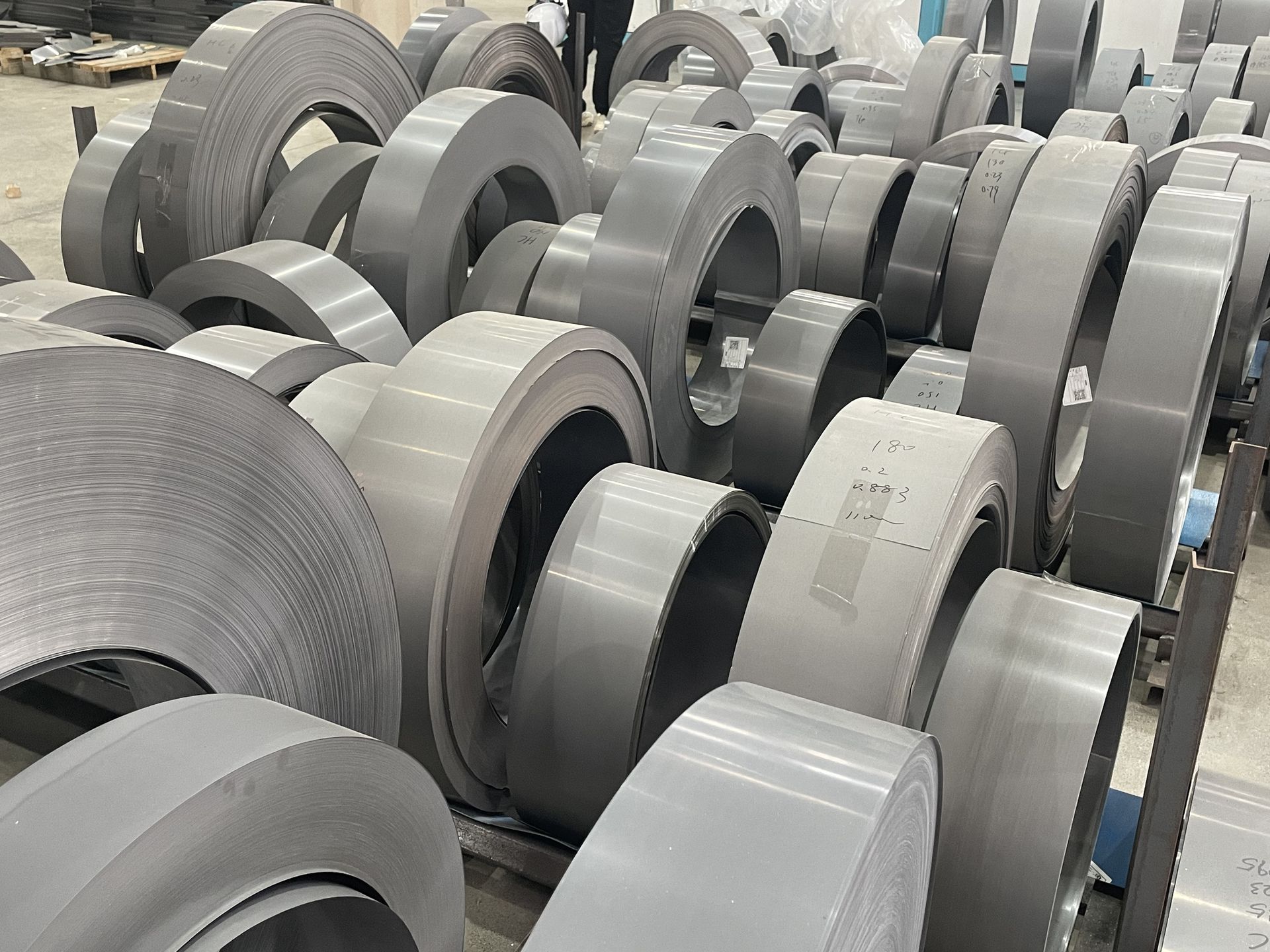
Manufacturers predominantly build transformer cores from transformer steel sheets, particularly cold rolled grain-oriented silicon steel. In short, cold rolled silicon steel combines high magnetic permeability with low core loss. That combination is why it dominates transformer core design. This guide explores transformer steel in depth. It covers how the material reduces energy loss, which grades matter most, and where industries use it.
What Is Cold Rolled Silicon Steel?
Transformer steel, commonly known as silicon steel, typically contains 0.8% to 4.8% silicon. Thanks to its high magnetic permeability, this material becomes the go-to choice for transformer cores. Advanced precision control systems (PCS) have changed the picture. With them, transformer steel allows higher magnetic induction in energized coils. As a result, designers can build more compact transformers.
Commonly Used Grain-Oriented Grades
- 0.23 mm thickness: B23G095, 23QG095, 23JGH095
- 0.27 mm thickness: B27G100, 27QG100, 27JGH100
- 0.30 mm thickness: B30G100, 30QG100, 30JGH100
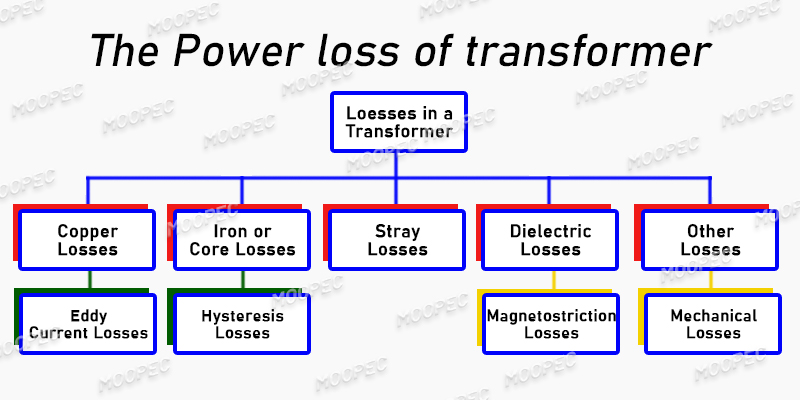
1. Transformer Power Losses
A transformer always works in the AC state. Consequently, power loss appears in two places. The first is the resistance of the coil. The second is the iron core, which the alternating current magnetizes. Engineers usually call the power loss in the iron core “iron loss.” Two causes create it: hysteresis loss and eddy current loss.
Hysteresis Loss in Transformer Steel
Hysteresis loss is the iron loss caused by the hysteresis phenomenon during the magnetization process of the iron core. The size of this loss is proportional to the area surrounded by the hysteresis loop of the material. The hysteresis loop of silicon steel is narrow. Consequently, the hysteresis loss of a silicon steel transformer core is small, which greatly reduces heat generation.
Why We Laminate the Core Instead of Using One Solid Block
Silicon steel already offers the advantages above. So why not use a whole piece of silicon steel as the iron core? Why process it into sheets instead? The answer is simple: a sheet core can reduce another type of iron loss — eddy current loss.
2. What Is Eddy Current Loss?
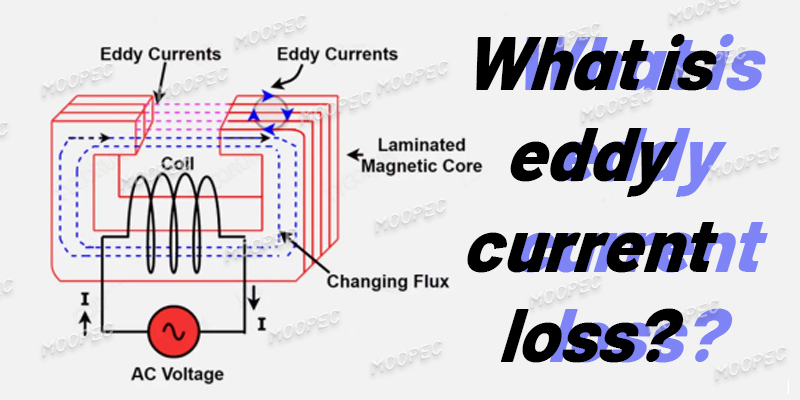
When the transformer works, alternating current flows in the coil. The magnetic flux it generates is also alternating. This changing magnetic flux produces an induced current in the iron core. The induced current circulates in a plane perpendicular to the magnetic flux. That is why we call it an eddy current.
How Laminated Silicon Steel Sheets Reduce Eddy Current Loss
Eddy current losses also heat the core. To reduce them, manufacturers stack the transformer core from silicon steel sheets. Each layer stays insulated from the next. This arrangement forces eddy currents through a smaller cross-section in a long, narrow circuit. In turn, resistance on the eddy current paths rises. At the same time, the silicon in the silicon steel raises the material’s resistivity. That effect also helps reduce eddy currents.
Sheet Thickness: Theory vs. Practice
For the iron core of a transformer, manufacturers generally use 0.35mm cold rolled silicon steel sheet. Workers cut it into long pieces to match the required core size. They then overlap the pieces into a shape like the picture below. Theoretically, thinner silicon steel sheets and narrower spliced sheets reduce eddy currents more effectively. This design helps reduce eddy current losses and heat generation, while also optimizing material usage and production efficiency.
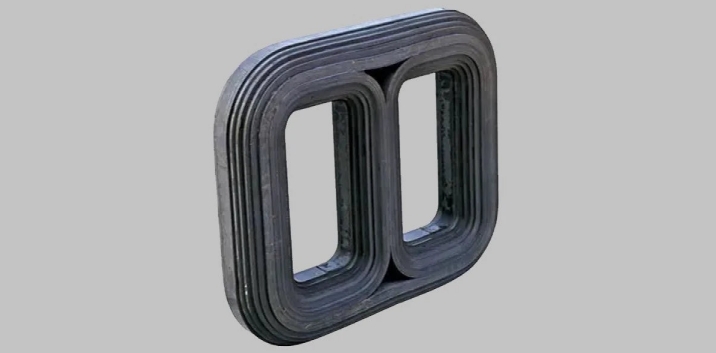
But when actually making silicon steel cores, engineers do not rely only on the favorable factors above. Making the iron core that way would greatly increase manufacturing hours. It would also reduce the effective core cross-section. Therefore, when you use silicon steel sheets to make transformer cores, start from the specific situation. Weigh the pros and cons, then choose the best size.
How a Transformer Core Guides Magnetic Flux
Transformers work on the principle of electromagnetic induction. Two windings sit on the closed iron core column: a primary winding and a secondary winding. The primary winding connects to the AC power supply voltage. Then an alternating current flows through the primary component and establishes a magnetic potential. Under the action of the magnetic potential, an alternating main magnetic flux appears in the iron core.
So why can a transformer boost and reduce the voltage? Lenz’s law explains it. The magnetic flux generated by the induced current always hinders the change of the circular magnetic flux. When the primary magnetic flux increases, the magnetic flux generated by the induced current opposes the primary magnetic flux.
According to Lenz’s Law, the induced magnetic field in the secondary winding opposes the change in magnetic flux from the primary. This opposition results in an induced alternating voltage proportional to the turns ratio. Therefore, the iron core is the magnetic circuit part of the transformer.
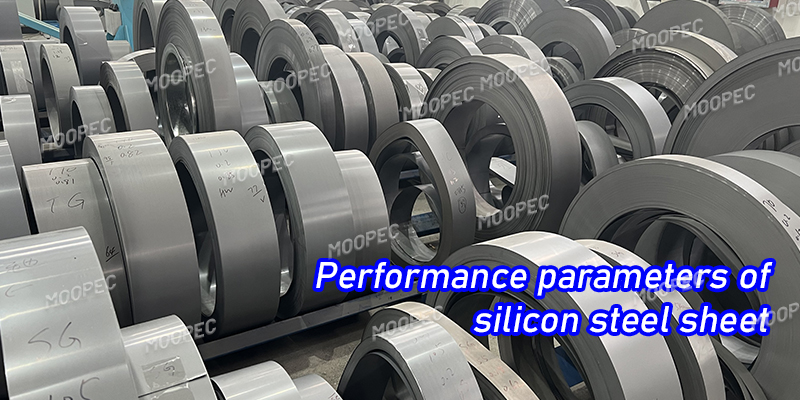
3. Performance Metrics of Cold Rolled Silicon Steel
Several key properties determine the performance of transformer steel sheets:
- Low iron loss: Grades like B27G100 or B30G120 offer reduced iron loss, which boosts transformer efficiency.
- High magnetic induction: Grades such as B23G090 or 23JG090 enable lighter and more compact transformer cores.
- High stacking factor: Uniform thickness and smooth surfaces improve core assembly.
- Excellent coating and welding characteristics: Particularly important in small motor applications.
- Magnetic aging resistance and annealing stability before shipment.
4. Types of Transformer Steel Sheets
The industry commonly calls silicon steel sheets for electrical purposes “silicon steel sheets” or “electrical steel sheets.” As the name suggests, this material is electrical steel with a silicon content of up to 0.8%–4.8%. Manufacturers produce it by hot and cold rolling.
Generally, the thickness is less than 1mm, so we call it a thin plate. Silicon steel sheets belong to the plate category and form an independent branch due to their special uses. Silicon steel sheets for electrical purposes have excellent electromagnetic properties. They are indispensable magnetic materials in the power, telecommunications, and instrument industries.
Manufacturers mainly classify silicon steel sheets in two ways.
Classification by Silicon Content
Silicon steel sheets divide into low silicon and high silicon according to their silicon content. Low silicon wafers contain less than 2.8% silicon. They have a certain mechanical strength, and manufacturers mainly use them to make motors. The trade calls these motor silicon steel sheets. High silicon wafers contain 2.8%–4.8% silicon. They have good magnetism but are brittle. Manufacturers mainly use them for transformer cores, which people commonly call transformer silicon steel sheets. In actual use, no strict boundary separates the two. Manufacturers commonly use high-silicon wafers for large motors, such as those that work with trolling motor batteries.
Classification by Production Technology
According to the production and processing technology, silicon steel sheets divide into hot rolling and cold rolling. Cold rolling yields two types: grain non-oriented and grain oriented. Among cold rolled silicon steel, grain-oriented transformer steel is particularly critical for high-efficiency transformer cores. It is gradually replacing hot-rolled and non-oriented types in power applications.
5. Applications of Transformer Steel Sheets
Hot-Rolled Silicon Steel Sheet for Electrical Purposes (GB5212-85)
Manufacturers make hot-rolled silicon steel sheets for electrical purposes from ferrosilicon soft magnetic alloy with low carbon loss. They hot-roll the alloy into sheets with a thickness of less than 1mm. Manufacturers divide hot-rolled silicon steel sheets by silicon content. Low silicon grades contain Si≤2.8%, and high silicon grades contain Si≤4.8%.
Cold-Rolled Silicon Steel Sheet for Electrical Purposes (GB2521-88)
Manufacturers make this kind of silicon steel sheet from electrical silicon steel containing 0.8%–4.8% silicon. They produce it by cold rolling. Cold rolled silicon steel sheets divide into two types: grain-non-oriented and grain-oriented steel sheets. Cold-rolled electrical steel sheet has the characteristics of smooth surface, uniform thickness, high stacking coefficient, and good punching performance.
It has higher magnetic induction and lower iron loss than hot-rolled electrical steel sheets. Using cold-rolled sheets instead of hot-rolled sheets to manufacture motors or transformers can reduce weight and volume by 0%–25%. If you use cold-rolled oriented sheet, the performance will be better. Using it instead of hot-rolled sheet or low-grade cold-rolled sheet can cut the transformer’s power consumption by 45%–50%. The transformer also becomes more reliable.
Manufacturers typically use non-oriented silicon steel in motors or low-frequency transformers. However, grain-oriented transformer steel remains the preferred material for high-performance power transformers. It ensures minimal core loss and superior magnetic flux guidance, and it also suits pulse transformers and magnetic amplifiers. Steel plate specifications and dimensions: thickness is 0.35mm, 0.50mm, 0.65mm; width is 800–1000mm; length is ≤2.0m.
Hot-Rolled Silicon Steel Sheet for Home Appliances (GBH46002-90)
Manufacturers represent the grade of hot-rolled silicon steel sheet for home appliances or home solar power systems by JDR. The number after JDR is the iron loss value ×100. The number after the horizontal line is the steel plate thickness (mm) ×100.
Hot-rolled silicon steel sheets for home appliances can have slightly lower electromagnetic performance requirements. Their minimum iron loss value (P15/50) is 5.40W/kg. Suppliers generally deliver them without washing. Manufacturers use this kind of silicon steel sheet on differential motors. Typical products include electric fans, washing machines, vacuum cleaners, and range hoods.
Why the Right Transformer Steel Matters
You may manufacture distribution transformers, pulse transformers, or industrial-grade magnetic amplifiers. In every case, the right transformer steel significantly impacts performance, size, and energy efficiency.
Why Choose MOOPEC for Cold Rolled Silicon Steel?
MOOPEC provides a comprehensive selection of Baosteel-oriented transformer steel grades, including B23G095, B27G100, and B30G120. We offer rapid delivery, small-batch customization, and expert support throughout material selection and core lamination. We ensure fast quoting within 12 hours and delivery in 7 days for global orders.
Looking for reliable, low-loss, high-performance transformer steel sheets? Choose MOOPEC — your trusted transformer steel solution partner.
Appendix: SEO Metadata (set these in the Yoast fields — do not paste into the post body)
- Focus keyphrase (new, 4 content words):
cold rolled silicon steel
- SEO title: Cold Rolled Silicon Steel: Transformer Steel Grades & Uses
- Slug: cold-rolled-silicon-steel
- Meta description: Cold rolled silicon steel cuts iron loss in transformer cores. Compare grain-oriented grades, sheet thicknesses, and key applications. Quote in 12 hours.
- Internal links used (replace paths with your real URLs):
transformer steel sheets→/transformer-steel-sheets/
transformer core→/transformer-core/
electrical steel→/electrical-steel/
core lamination→/core-lamination/
- Suggested extra internal links (pick 2–3): point
grain-oriented silicon steelat your CRGO page, pointBaosteelat your Baosteel grades article, pointeddy current lossat the motor core lamination guide.
- Synonyms to reuse in subheadings: grain-oriented silicon steel, transformer steel, silicon steel sheets, CRGO.



