
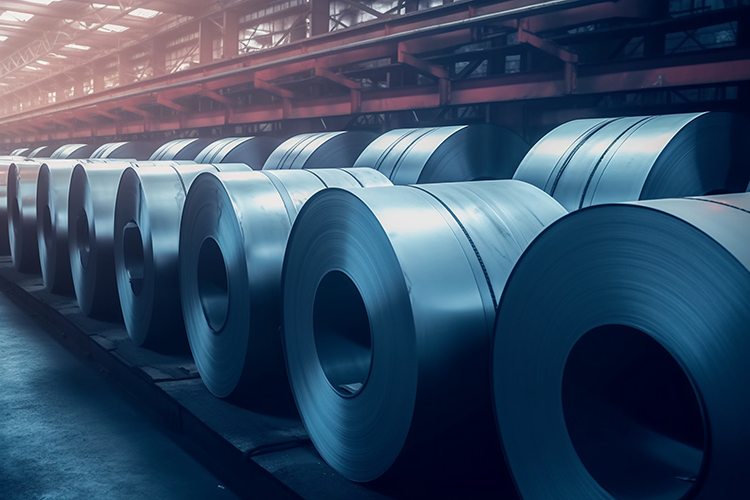
As an important material in the automobile manufacturing industry, cold-rolled steel sheets play a key role. They not only excel in quality requirements but also offer great performance advantages. Moreover, through continuous innovation and development, cold-rolled steel plates are presenting an exciting future trend.
What Is Cold-Rolled Steel Plate?
First, cold-rolling produces cold-rolled steel sheets. Cold rolling means re-rolling and processing a hot-rolled steel plate at room temperature. This process gives cold-rolled steel sheets an excellent surface finish and uniform thickness. In addition, manufacturers subject cold-rolled steel sheets to processes such as descaling, stress removal and tempering, which further improve the strength and toughness of the material.
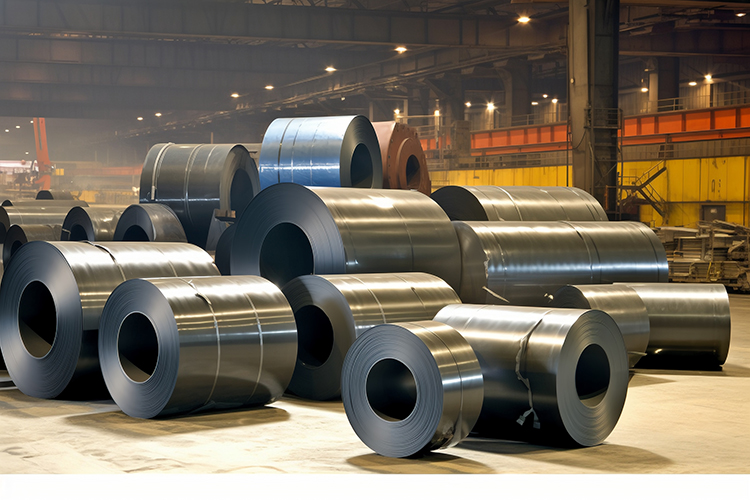
Figure 1: Cold-rolled steel coil
Common cold-rolled automotive grades cross-referenced across international standards:
ASTM | EN | MS50002 | Q/BQB | DIN |
| CS Type C | DC01 | CR01 | DC01/SPCC/BLC | ST12 |
| CS Type A,B | DC03 | CR02 | DC03/SPCD/BLD | ST13 |
| CS TypeA,B | DC04 | CR03 | DC04/SPCE/BUSD | ST14 |
| DDS | DC05 | CR04 | DC05/SPCF/BUFD | ST15 |
| EDDS | DC06 | CR05 | DC06/SPCG/BSUFD | ST15 |
| BHS Grade180 | HC180B | BHC180Y290T | CR180B2 | HC180B |
| BHS Grade210 | HC220B | BHC210Y310T | CR210B2 | HC220B |
| BHS Grade240 | HC260B | BHC240Y340T | CR240B2/CR270B2 | HC260B |
| BHS Grade300 | HC300B | – | CR300B2 | HC300LB |
| – | HC260LA | LAC270Y340T | CR240LA/CR270LA | HC260LA |
| HSLAS grade 310 class 2 | HC300LA | LAC300Y360T | CR300LA | HC300LA |
| HSLAS grade 340 class 2 | HC340LA | LAC340Y410T | CR340LA | HC340LA |
| HSLAS grade 380 class 2 | HC380LA | LAC380Y450T | CR380LA | HC380LA |
| HSLAS grade 410 class 2 | HC420LA | LAC420Y480T | CR420LA | HC420LA |
| HSLAS grade 450 class1 | HC460LA | – | – | HC460LA |
| – | HC500LA | LAC500Y560T | CR500LA | HC500LA |
| HSLAS-F grade 550 | – | LAC550Y620T | – | HC550LA |
Cold-rolled galvanized grades (mild steel):
Q/BQB 420-2003 | EN 10142-2000 | JIS G3302-1994(Z) | JFS A3011-1998(ZF) | ASTM A653M-02a |
| DC51D+Z | DX51D+Z, +ZF | SGCC | JAC270C | CS Type C |
| (St01Z, St02Z, St03Z) DC51D+ZF | DX51D+Z, +ZF | SGCC | JAC270C | CS Type C |
| DD51D+Z (St01ZR St02ZR) | DX51D+Z, +ZF | SGHC | JAH270C | CS Type C |
| DC52D+Z(St04Z) DC52D+ZF | DX52D+Z, +ZF | SGCD1 | JAC270D | CS Type A, Type B |
| DC53D+Z (St05Z) DC53D+ZF | DX53D+Z, +ZF | SGCD2 SGCD3 | JAC270E | FS Type A, Type B |
| DC54D+Z(St06Z) DC54D+ZF | DX54D+Z, +ZF | – | JAC270F | DDS |
| DD54D+Z(St06ZR) | DX54D+Z, +ZF | – | – | DDS |
| DC56D+Z(St072) DC56D+ZF | DX56D+Z, +ZF | – | JAC270G | EDDS |
Quality Requirements for Cold-Rolled Automotive Sheets
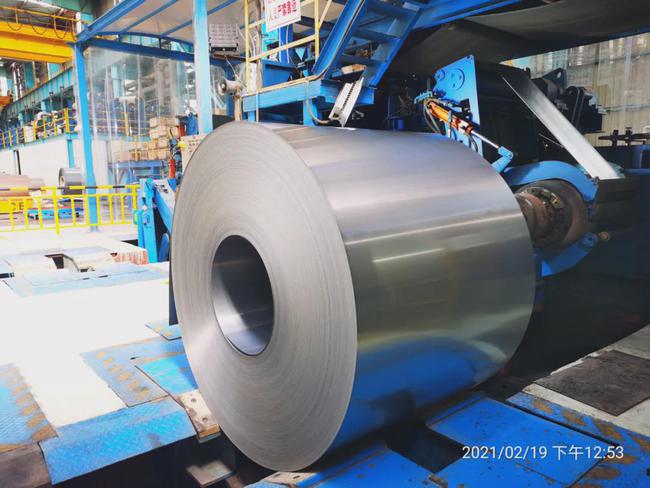
Generally, the automobile industry sets the following requirements for the cold-rolled steel sheets it uses:
- Excellent formability — namely a high plastic strain ratio (r value), high uniform elongation (δu), high total elongation (δt), low yield strength (σs), low aging index (AI) and low yield elongation — for stamping complex automotive panels.
- Excellent anti-sag ability and sufficient structural rigidity to avoid sags during manufacture and use, and especially to absorb as much energy as possible in sudden collision accidents, protecting the safety of occupants.
- Good welding performance to ensure effective connection of parts, so that the strength and performance of the solder joints and their surrounding areas remain stable.
- Excellent surface morphology and smoothness, with good spraying performance and adhesion to paint coatings, to achieve a beautiful surface.
- High corrosion resistance.
- Good shape and flatness of the board surface, together with strict dimensional accuracy and performance uniformity.
- Good sound absorption and vibration reduction, applied to certain parts to reduce the booming noise of the car while driving.
Because cold-rolled automotive sheets carry these special quality requirements, their production process is complicated and difficult. Therefore, automobile sheet manufacturers follow the principle of system consistency in actual production — they plan and manage smelting, continuous casting, hot rolling, cold rolling, annealing and coating processes under one unified production plan.
Development and Application of Cold-Rolled Automotive Sheets
As a key material in the automotive industry, cold-rolled automotive sheets have seen wide application and continuous development in recent years. Four key trends stand out:
Lightweight design
With growing environmental awareness and stricter fuel efficiency requirements, lightweight design has become an important trend in the automotive industry. Thanks to its excellent strength-to-weight ratio and good stamping properties, cold-rolled automotive sheet is ideal for lightweighting automobiles. Manufacturers use it widely in body structures, doors, hoods and roofs to reduce vehicle weight and improve fuel economy and driving performance.
Application of high-strength steel sheets
To meet automobile collision safety requirements, high-strength steel sheets within the cold-rolled family have been adopted on a wide scale. Through reasonable alloy design and heat treatment processes, high-strength steel plates deliver higher strength and rigidity, and they effectively improve the impact resistance and safety of the body structure.
Integration of composite materials
To further improve performance, more and more composite materials are entering automotive sheets. By combining cold-rolled steel sheets with other materials — such as aluminum alloys and high-performance polymers — engineers can obtain better properties while keeping the excellent characteristics of cold-rolled sheets, including corrosion resistance, flexural performance and noise reduction.
Intelligent manufacturing and process optimization
As manufacturing technology advances, the production process of cold-rolled automotive sheets keeps being optimized and improved. Intelligent manufacturing technologies — advanced automation equipment, robotics and intelligent monitoring systems — raise production efficiency, quality stability and resource utilization, and they give manufacturers a higher level of control and flexibility.
Future Trends and Directions
Generally speaking, cold-rolled automotive sheet continues to expand its application fields, while improving and innovating in material performance, manufacturing process and production efficiency. Looking ahead, as new material technologies develop and the needs of the automotive industry evolve, several development directions stand out:
Advanced high-strength steel plates
As crash safety requirements keep rising, demand for high-strength steel plates grows accordingly. Future cold-rolled automotive sheets will focus more on improving strength and rigidity to meet structural requirements, and research into advanced high-strength steels will remain a key area for delivering lighter, stronger materials without sacrificing safety or performance.
Multi-material composite sheets
To satisfy the industry’s needs for lightweighting and energy saving, cold-rolled automotive sheets may be combined with other materials, such as aluminum alloys and carbon fiber composites. Through multi-material design, engineers can achieve a better performance balance across different parts — providing higher strength, stiffness and corrosion resistance while reducing vehicle weight.
Manufacturing process optimization
Future production will put more emphasis on process optimization and efficiency improvement. Advanced technologies such as hot continuous rolling and continuous annealing can raise production line capacity and material quality stability. Furthermore, intelligent manufacturing and data analytics will deepen the control and management of production, enabling efficient and sustainable output.
Environmental sustainability
As environmental awareness improves, the manufacture and application of cold-rolled automotive sheets will increasingly prioritize environmental sustainability. Adopting greener materials and processes, reducing energy consumption and waste emissions, and minimizing environmental impact will become an important direction of future development.
In conclusion, cold-rolled automotive sheet is an important material in the automotive industry, and its development trends include the application of high-strength steel sheets, multi-material composites, manufacturing process optimization, and environmental sustainability. As technology advances and market demand shifts, cold-rolled automotive sheets will continue to drive improvements in automotive lightweighting and safety performance, contributing to the ongoing development of the automotive industry.



