

1. The Need for Lightweighting
Reducing vehicle weight is a key aspect of modern automotive design. The benefits are clear:
- Every 1% reduction in vehicle weight saves 0.6% to 1.0% in fuel consumption.
- For every 100 kg reduction in vehicle weight, a car emits approximately 5 g/km less CO2.
- Using just 1 kg of aluminum in a car saves up to 20 kg of emissions over the vehicle’s lifetime.
- Moreover, as vehicles become more feature-rich, lightweighting helps offset the weight added by advanced components.
The main targets for weight reduction include the engine, chassis, and body. Among these, the car body contributes up to 30% of a vehicle’s total weight. Therefore, increasing the use of aluminum in the car body has a pivotal impact on achieving lightweight goals.
2. Methods for Lightweighting
Engineers pursue lightweighting through two main approaches:
- Optimizing the vehicle frame structure: redesigning and optimizing the structural elements of the car.
- Material substitution: replacing traditional steel with high-strength, lightweight materials such as high-strength steel and aluminum alloys.
3. Aluminum Alloys – The Ideal Solution for Automotive Lightweighting
3.1 Aluminum Alloy Fundamentals
Aluminum offers an excellent density-to-strength ratio. Its density of 2.7 g/cm³ equals about one-third that of steel (7.8 g/cm³), which allows roughly 50% weight savings when it replaces steel. In addition, aluminum naturally forms a stable oxide layer that enhances its corrosion resistance. It also boasts good casting properties, thanks to its low melting point and high fluidity, so manufacturers can produce complex components more easily.
Alloying aluminum with other elements further enhances its strength and hardness. Certain aluminum alloys gain strength through heat treatment and achieve tensile strengths of over 600 MPa. Furthermore, their thermal and electrical conductivity is three times that of steel, which adds to their versatility.
3.2 Types of Aluminum Alloys
Aluminum alloys fall into two broad types:
- Wrought aluminum alloys: ideal for pressure processing; they can be strengthened through cold deformation and heat treatment.
- Cast aluminum alloys: commonly used for engine parts, housing components, and other vehicle parts.
3.3 Current Application of Aluminum in Vehicles
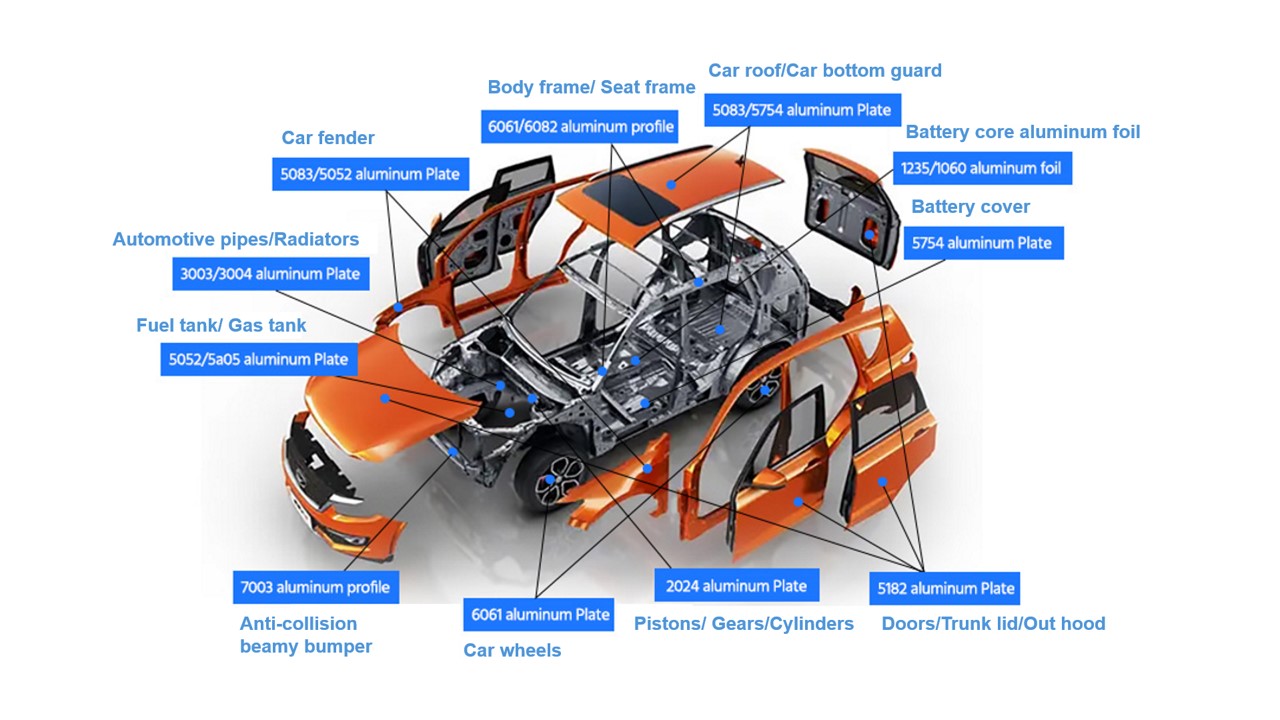
Automakers use both cast and wrought aluminum alloys in today’s vehicles. Cast aluminum components serve primarily in the engine, housing, and chassis, while wrought aluminum alloys form car bodies. Typical body applications include hoods, roof panels, doors, fenders, and trunk lids.
Traditionally, automakers choose Al-Cu-Mg (2000 series), Al-Mg (5000 series), and Al-Mg-Si (6000 series) alloys for auto bodies. Because of aluminum’s lightweight and high-strength properties, it also works well in engine mounts, bumpers, and structural body elements.
4. Aluminum Alloys for Auto Body Panels
4.1 5000 Series Alloys for Inner Panels
The 5000 series alloys, based on aluminum-magnesium (Al-Mg), are non-heat-treatable alloys. Their formability surpasses that of the 6000 series, so manufacturers rely on them primarily for automotive inner coverings and structural components. Common grades include 5754 and 5182. These grades offer excellent yield strength control through magnesium content and grain size adjustment, which makes them ideal for complex panel forming.
Composition of typical 5000 series alloys (wt%):
| Alloy No. | Si | Fe | Cu | Mn | Mg | Cr | Zn | Ga,V,NI, B,zR,etc. | Ti | Others Individual | Others Total | AL |
| 5052 | 0.25 max. | 0.40 max | 0.10 max. | 0.10 max. | 2.2 to 2.8 | 0.15 to 0.35 | 0.10 max. | — | — | 0.05 max. | 0.15 max. | Remainder |
| 5182 | 0.20 max. | 0.35 max. | 0.15 max. | 0.20 to 0.50 | 4.0 to 5.0 | 0.10 max. | 0.25 max. | — | 0.10 max. | 0.05 max. | 0.15 max. | Remainder |
| 5754 | 0.40 max. | 0.40 max | 0.10 max. | 0.50 max. | 2.6 to 3.6 | 0.30 max. | 0.20 max. | Mn+Cr 0.10 to 0.6 | 0.15 max. | 0.05 max. | 0.15 max. | Remainder |
4.2 6000 Series Alloys for Exterior Panels
The 6000 series alloys contain magnesium and silicon, and sometimes copper. Because they are heat-treatable, they suit exterior car panels well. Grades such as AA6009, AA6010, AA6016, and AA6111 serve markets worldwide: AA6111 is preferred in the United States for its high strength and formability, while EN-6016 is favored in Europe for exterior applications. Compared with higher-strength copper alloys, these alloys offer better formability and corrosion resistance, making them an excellent choice for high-quality exterior panels.
The shift toward the 6000 series reflects OEMs’ pursuit of higher strength. Currently, over 80% of aluminum alloys used by automotive manufacturers belong to this series. These alloys balance high strength, weldability, and formability, which makes them versatile across various automotive applications.
4.3 Applications of Aluminum-Magnesium Alloys in Chassis
Beyond body panels, the non-heat-treatable 5000 series alloys also play a significant role in automotive chassis components, again thanks to their excellent formability during complex shaping processes. For instance, BMW builds the rear subframe of the 5 Series from 3.5 to 4.0 mm thick sheet metal using hydroforming and welded tube construction, which delivers a high level of functionality and integration.
Similarly, the latest BMW 7 Series features a mix of tubing and casting that reduces weight to just 14.1 kg—a clear demonstration of advanced aluminum use in modern automotive engineering.
5. Conclusion
Lightweighting automotive components with aluminum alloys has become an essential step in the evolution of vehicle design. With aluminum’s impressive density-to-strength ratio, excellent corrosion resistance, and versatility in both casting and forming, it plays a pivotal role in enhancing energy efficiency and safety. As the demand for stronger, lighter vehicles grows, the use of 5000 and 6000 series aluminum alloys is likely to expand, offering an optimized blend of strength, formability, and durability.



