
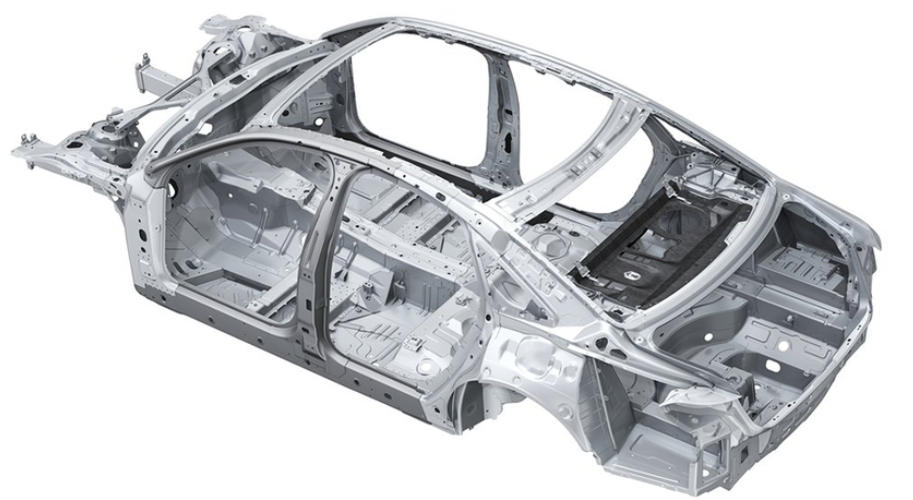
Automotive aluminum sheet materials have become the default lightweighting solution for modern car bodies. Aluminum is roughly one-third as dense as steel. As a result, replacing steel with aluminum alloys can cut component weight by about half. That saving translates directly into lower fuel consumption and CO₂ emissions. This guide covers five areas. First, it sets out the basic knowledge behind automotive aluminum and the main alloy families. Second, it works through an equal-strength calculation example. Finally, it reviews the production process for aluminum sheets. The guide then closes with the surface treatment methods used in Japan, the US, and Europe.
I. Basic Knowledge of Aluminum Alloys
1.1 The Inevitability of Lightweighting
Lightweighting rests on a simple chain of numbers. For every 1% reduction in vehicle weight, fuel consumption falls by 0.6%–1.0%. Similarly, every 100 kg of weight reduction cuts CO₂ emissions by approximately 5 g/km. In addition, each 1 kg of aluminum in a passenger car can reduce about 20 kg of exhaust emissions. That gain accrues over the vehicle’s service life. Because vehicle exhaust emissions rise with fuel consumption, these gains compound over the life of the vehicle. Meanwhile, modern vehicles are becoming increasingly sophisticated with more additional equipment. As a result, lightweighting has become an inevitable trend.
1.2 Main Targets of Automotive Lightweighting
Vehicle mass is spread across several systems, and some offer more weight-reduction potential than others. For example, the engine, chassis, and body account for a large proportion of a passenger car’s total mass. That share includes interior and exterior parts. Therefore, these systems offer significant weight-reduction potential. The body alone accounts for about 30% of the total vehicle mass. As a result, aluminum substitution in the body structure is particularly critical. The table below breaks the vehicle mass down by system.
| Item | Engine | Chassis (Suspension System) | Body | Drivetrain | Interior & Exterior Trim | Others |
| Weight Ratio (%) | 10–15% | 19–24% | 20–28% | 5–10% | 20–25% | 8–13% |
1.3 Characteristics of Aluminum Alloys
Aluminum differs from steel in several ways that matter for body engineering. First, the density of aluminum is low (2.7 g/cm³), approximately one-third that of steel (7.8 g/cm³). As a result, replacing steel with aluminum alloys can reduce weight by about 50%. In addition, aluminum naturally forms a dense and stable oxide film on its surface, which gives it excellent corrosion resistance. Due to its low melting point and good fluidity, aluminum also has excellent castability. As a result, it suits the manufacture of complex parts. When manufacturers add one or more alloying elements, aluminum alloys form. These offer higher strength and hardness than pure aluminum. Moreover, some aluminum alloys can be heat treated, achieving tensile strengths above 600 MPa. Finally, thermal and electrical conductivity are approximately three times that of steel.
1.4 Classification of Aluminum Alloys
II. Introduction to Automotive Aluminum Materials
2.1 Performance Parameters
Automotive aluminum alloys mainly use heat-treatable 6000-series and non-heat-treatable 5000-series alloys. Among them, 5038 and 5183 are the most commonly used grades for car bodies. In particular, tests show that the R-value has no obvious influence on the stamping formability of aluminum sheets. In addition, the table below lists the key performance parameters for the main alloy types.
| Alloy Type | Yield Strength (N/mm²) | Tensile Strength (N/mm²) | Elongation (%) | Avg. Elongation (%) | Hardness (HV) | n-value | r-value |
| 1100-O | 31 | 95 | 38 | 30 | 24 | 0.29 | 0.85 |
| 1100-H24 | 139 | 142 | 13 | – | 45 | – | 0.85 |
| 3003-O | 40 | 107 | 33 | 29 | 30 | 0.21 | 0.67 |
| 3003-H14 | 157 | 169 | 5 | – | 49 | 0.07 | 0.50 |
| 3004-O | 62 | 177 | 25 | 22 | 48 | 0.28 | 0.71 |
| 3004-H24 | 175 | 215 | 9 | 8 | 76 | 0.12 | 0.71 |
| 5052-O | 107 | 213 | 24 | 22 | 52 | 0.32 | 0.74 |
| 5052-H24 | 212 | 269 | 13 | 10 | 80 | 0.13 | 1.05 |
| 5182-O | 125 | 264 | 31 | 28 | 26 | 0.31 | 0.61 |
| 5182-H24 | 273 | 350 | 11 | 10 | 91 | 0.13 | 0.75 |
| 6061-O | 45 | 125 | 30 | 25 | – | 0.28 | 0.66 |
| 6061-T4 | 197 | 271 | 24 | 20 | 64 | 0.20 | 0.74 |
| Cold-Rolled Steel Sheet | 181 | 298 | 46 | 23 | 45 | 0.21 | 0.2 |
2.2 Performance Requirements
Automotive aluminum sheets must meet mechanical and corrosion-resistance standards. In addition, they must satisfy the following requirements:
- First, the sheet needs good formability, a low yield ratio, and a high forming limit.
- Second, surface quality must be smooth.
- Third, weldability must meet the requirements of automotive component welding processes.
- In addition, the sheet needs good bake-hardening performance and high dent resistance.
- Finally, it needs excellent surface treatment and paintability, plus adequate resistance to natural aging.
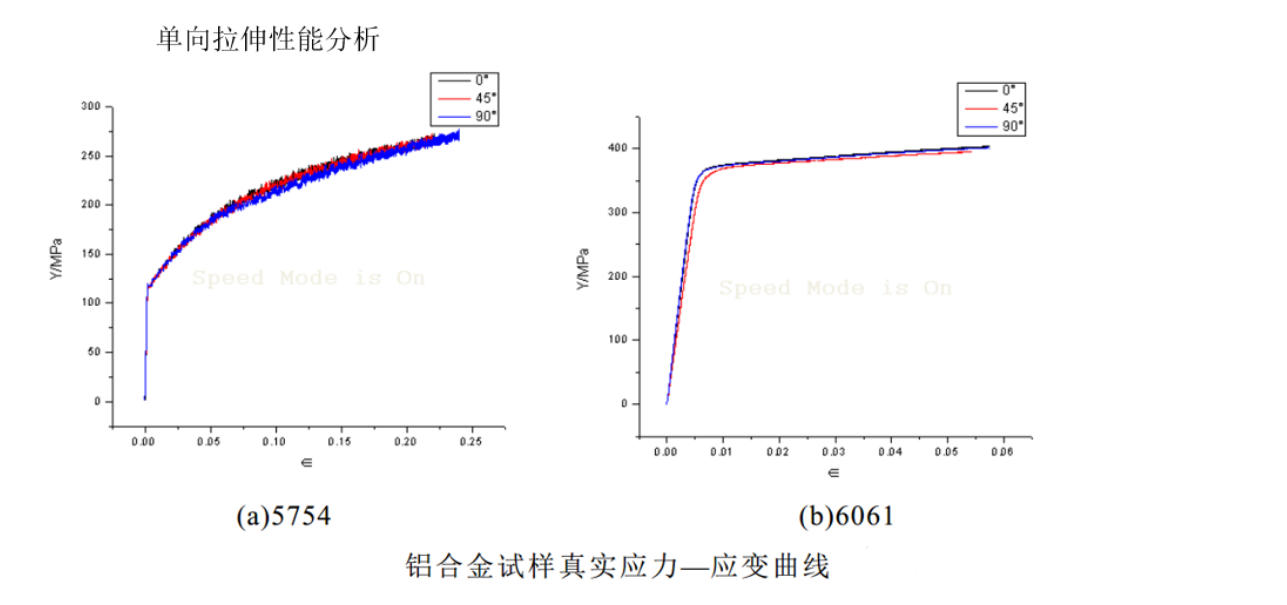
The real stress-strain curve graph of the aluminum alloy sample
Aluminum Usage in Automotive Outer Panels in Europe and North America
Based on relevant data, the following performance targets apply to finished sheets used in automotive body panels.
In the T4(p) condition, the targets are:
- Yield strength: 90–140 MPa
- Tensile strength: 220–285 MPa
- Total elongation: ≥20%
- n-value: ≥0.27 (strain-hardening exponent)
- r-value: ≥0.65 (0°), ≥0.40 (45°), ≥0.55 (90°)
After 2% pre-strain and baking, the target changes:
- Yield strength: 160–260 MPa
2.3 Alloy Grades and Application Areas
| Aluminum Series | Chemical Composition | Typical Automotive Applications | Key Characteristics | Key Characteristics |
| 2000 Series | Al-Cu-Mg (Al₂Cu₂Mg) | Structural frames, seat structures | 2000-series alloys are heat-treatable and strengthened by precipitation hardening. They offer good formability, high strength, and good weldability, with excellent bake-hardening response. However, their corrosion resistance is inferior to other aluminum alloy series. | 2036, 2022 |
| 5000 Series | Al-Mg (Al₂Mg) | Hood panels, doors, floor panels, trim parts | 5000-series alloys are non-heat-treatable. They exhibit good corrosion resistance and weldability, but in the annealed condition may show Lüders bands and delayed yielding during forming. Therefore, they are mainly used for complex-shaped inner body panels. | ANV5138-O, X5085-O, 5083 |
| 6000 Series | Al-Mg-Si (Al₂Mg₂Si) | Doors, floor panels, seat components | 6000-series alloys are heat-treatable aluminum alloys with relatively high strength, good formability, and excellent corrosion resistance. Compared with steel, 6000-series T4 sheets show similar yield and tensile strengths, while the hardening index is significantly higher than that of steel sheets. | 6009, 6010, 6111, 6181A, 6016 |
Aluminum alloys for automotive body panels mainly include the 2000, 5000, and 6000 series. In practice, manufacturers mainly use the 2000 and 5000 series for inner panels. They reserve the 6000 series for outer panels. As a result, 5000-series and 6000-series aluminum sheets typically replace conventional steel sheets. The table below lists the international grades and chemical compositions of automotive body aluminum alloys.
| Alloy | Si | Fe | Cu | Mn | Mg | Cr | Zn | Ti | Al |
| 2036 | 0.5 | 0.5 | 2.2–3.0 | 0.1–0.4 | 0.3–0.6 | 0.1 | 0.25 | 0.15 | Rem. |
| 2037 | 0.5 | 0.5 | 1.4–2.2 | 0.1–0.4 | 0.3–0.8 | 0.1 | 0.25 | 0.15 | Rem. |
| 2038 | 0.5–1.3 | 0.6 | 0.8–1.8 | 0.1–0.4 | 0.4–1.0 | 0.2 | 0.5 | 0.15 | Rem. |
| 5023 | 0.25 | 0.4 | 0.2–0.5 | 0.2 | 5.0–6.2 | 0.1 | 0.25 | 0.1 | Rem. |
| 5182 | 0.2 | 0.35 | 0.15 | 0.2–0.5 | 4.0–5.0 | 0.1 | 0.25 | 0.1 | Rem. |
| 5754 | 0.4 | 0.4 | 0.1 | 0.5 | 2.6–3.6 | 0.3 | 0.2 | 0.15 | Rem. |
| 6009 | 0.6–1.0 | 0.5 | 0.15–0.6 | 0.2–0.8 | 0.4–0.8 | 0.1 | 0.25 | 0.1 | Rem. |
| 6010 | 0.8–1.2 | 0.5 | 0.15–0.6 | 0.2–0.8 | 0.6–1.0 | 0.1 | 0.25 | 0.1 | Rem. |
| 6111 | 0.6–1.1 | 0.4 | 0.5–0.9 | 0.1–0.45 | 0.5–1.0 | 0.1 | 0.15 | 0.1 | Rem. |
| 6016 | 1.0–1.5 | 0.5 | 0.2 | 0.2 | 0.25–0.6 | 0.1 | 0.2 | 0.1 | Rem. |
| 6016 | 0.8–1.5 | 0.05–0.2 | 0.01–0.11 | 0.02–0.1 | 0.45–0.7 | 0.1 | 0.25 | 0.15 | Rem. |
2.4 Comparison of 6xxx and 5xxx Series Aluminum Alloys for Automotive Bodies
Typical grades include 6016, 6111, 6022, 6181, 5052, 5182, and 5754, with thickness generally between 0.7–2.0 mm. The two families harden in different ways.
(1) 6xxx Series Al-Mg-Si(-Cu) Alloys
First, 6xxx-series alloys offer high strength and good formability, and manufacturers use them widely for automotive outer panels. These alloys require good plasticity before painting. They also need a high precipitation hardening response during baking (bake-hardening). Therefore, suppliers deliver them as heat-treatable alloys with good formability, corrosion resistance, strength, and high-temperature performance. After stamping and paint baking, their strength increases significantly. In fact, the yield and tensile strengths of T4 sheets are comparable to steel. The n-value, by contrast, exceeds that of steel.
(2) 5xxx Series Al-Mg Alloys
Second, 5xxx-series alloys are non-heat-treatable, and they feature medium strength, good corrosion resistance, good formability, and excellent weldability. However, they are prone to several defects. These include Lüders elongation after room-temperature storage and surface wrinkling after stamping. In addition, ductility falls as Fe content rises, and the alloy softens after baking. Their further disadvantages include delayed yielding, Lüders lines, and the orange-peel effect when grain size exceeds 100 μm.
The table below compares the mechanical and stamping performance of aluminum alloys and cold-rolled steel.
| Alloy / Temper | Total Elongation (%) | Uniform Elongation (%) | n-value | r-value | Cup Drawing Depth (mm, 180°) | Min. Bend Radius |
| 2022-T4 | 26.0 | 20.0 | 0.25 | 0.63 | 9.6 | 1t |
| 2117-T4 | 25.0 | 20.0 | 0.25 | 0.59 | 8.6 | 1t |
| 2036-T4 | 24.0 | 20.0 | 0.23 | 0.75 | 9.1 | 1t |
| 2037-T4 | 25.0 | 20.0 | 0.24 | 0.70 | 9.4 | 1t |
| 2038-T4 | 25.0 | – | 0.26 | 0.75 | – | 1/2t |
| 5182-O | 26.0 | 19.0 | 0.33 | 0.80 | 9.9 | 2t |
| 5182-SSF | 24.0 | 19.0 | 0.31 | 0.67 | 9.7 | 2t |
| X5082-O | 30.0 | 20.0 | 0.30 | 0.66 | – | 1t |
| 6009-T4 | 25.0 | 20.0 | 0.23 | 0.70 | 9.7 | 1/2t |
| 6010-T5 | 24.0 | 19.0 | 0.22 | 0.70 | 9.1 | 1t |
| 6111-T4 | 27.5 | 22.0 | – | – | 8.4 | 1/2t |
| 6016-T4 | 28.1 | 24.6 | 0.26 | 0.70 | – | – |
| Deep-Drawing Steel | 42.2 | 20.2 | 0.23 | 1.39 | 11.9 | 0 |
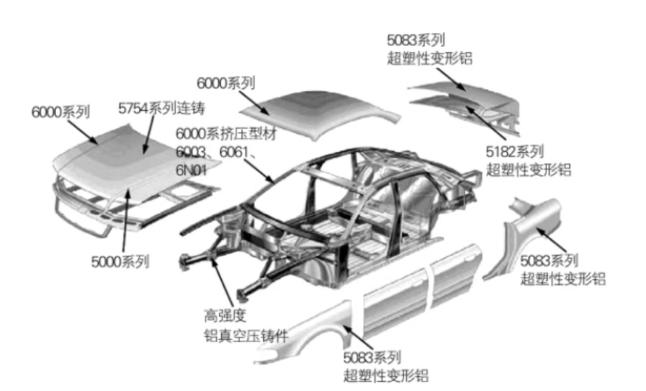 Aluminum alloy is widely used in automobiles
III. Equal-Strength Calculation Example: Aluminum vs. Steel
To replace steel with aluminum while maintaining part performance, engineers need equal-strength calculations. The table below shows a worked example for an engine hood outer panel.
| Part Name | Steel Sheet Thickness (mm) | Steel Sheet Weight (kg) | Steel Sheet Weight (kg) | Aluminum Sheet Thickness (mm) | Aluminum Sheet Weight (kg) |
| Engine Hood Outer Panel | 0.75 | 8.5 | 1.0 | 3.9 | 54% |
| Engine Hood Outer Panel | 0.75 | 10.47 | 1.0 | 4.5 | 54% |
Note: t = sheet thickness.
Based on bending stiffness and bending strength, thickness calculations work as follows.
(1) Based on bending stiffness:
tₐₗ / tₛ = (Eₛ / Eₐₗ)¹ᐟ³
Here Eₛ = 210 GPa and Eₐₗ = 61 GPa, so tₐₗ / tₛ = 1.5.
(2) Based on bending strength:
tₐₗ / tₛ = (σₛ / σₐₗ)¹ᐟ²
Here σₛ = 184.4 MPa and σₐₗ = 116.9 MPa, so tₐₗ / tₛ = 1.26.
Therefore, aluminum sheet thickness increases from 0.7 mm to 1.0 mm.
IV. Production Process of Automotive Aluminum Sheets
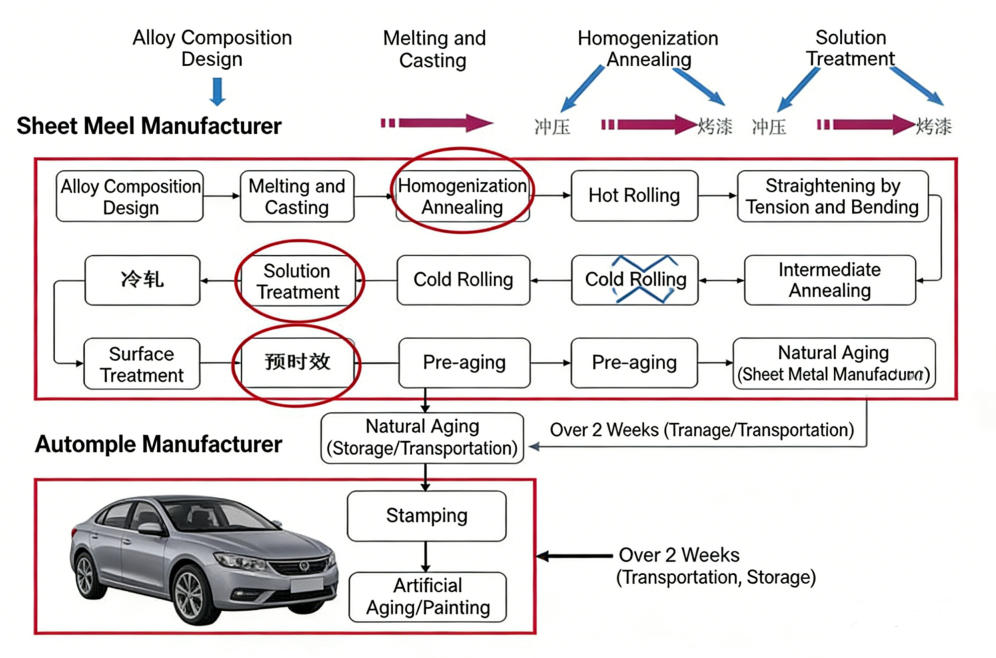
The production process of aluminum alloy vehicle body panels
4.2 A Typical Process Flow Diagram for the Production of ABS Plates and Strips
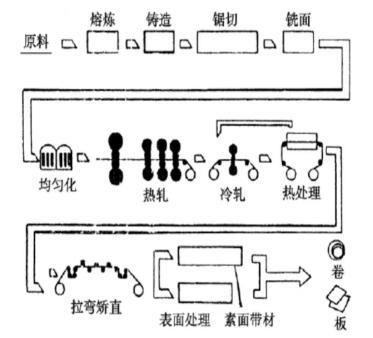
A typical process flow diagram for the production of ABS plates and strips in an aluminum processing plant
4.3 Schematic Diagram of the Process Flow for Manufacturing AVT Body with ABS
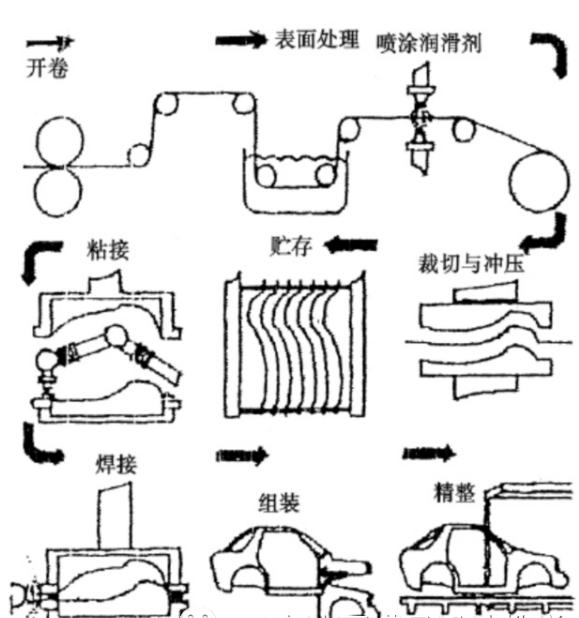
4.4 ABS Fully Continuous Production Line
Microstructural evolution during processing of 6xxx series aluminum sheets:
V. Surface Treatment of Aluminum Sheets
Purpose of Surface Treatment
Surface treatment serves three purposes:
- Improve lubricant adhesion and stamping formability.
- Enhance paint adhesion.
- Facilitate subsequent processing.
Process Route and Conversion Coatings
The process route combines MF / EDT / EBT texturing with cleaning (alkaline + acid), conversion treatment, and lubrication. Chemical conversion coatings include chromate (toxic), zirconium/titanium systems (Alodine, Garbond, Envirox), and anodizing.
Lubrication Methods
Lubrication methods fall into two groups:
- Industrial oil (mainly North America)
- Dry lubrication film / wax (mainly Europe)
Dry lubrication brings clear advantages, such as improved deep-drawing, stable transport, easy handling, and compatibility with welding and painting. However, it also carries disadvantages, including lubricant selection per die, residue accumulation, and more difficult welding.
Practices in Japan, the US, and Europe
The table below summarizes aluminum automotive sheet and surface treatment practices in Japan, the US, and Europe.
| Panel Type | Panel Type | Item | Japan | United States |
| Outer Panel | Alloy Grades | 6016, 6022, 5xxx series | 6111, 6022 | 6016 |
| Outer Panel | Surface Roughness | Smooth MF finish | MF finish | EDT / EBT |
| Outer Panel | Surface Pretreatment | Degreasing, pickling, phosphating | None | Pickling + Zr/Ti chemical conversion |
| Outer Panel | Lubricant | Mineral oil | Mineral oil | Mineral oil or drawing compound |
| Inner Panel | Alloy Grades | 6016, 6022, 5xxx series | 2008, 6111, 6022, 5182 | 5151, 5182, 6016, 6181A |
| Inner Panel | Smooth MF finish | Smooth MF finish | MF finish | MF, EDT |
| Inner Panel | Surface Pretreatment | Degreasing, pickling, phosphating | None | Pickling + Zr/Ti chemical conversion |
| Inner Panel | Lubricant | Mineral oil | Mineral oil | Mineral oil or drawing compound |



