
Table of Contents
Introduction
The Role of Rectangular Laminations in Distribution Transformers
Why CRGO Steel is Essential
Engineering Logic Behind Core Efficiency
Challenges Faced by Transformer Manufacturers
MOOPEC’s Solution: From Material to Core Components
Key Processing Capabilities
Application Scenarios and Value
Industry Trends and Future Requirements
Key Takeaways
FAQ
1. Introduction
In today’s global power infrastructure, distribution transformers play a critical role in ensuring stable and efficient electricity delivery. Installed across residential, commercial, and industrial environments, these transformers operate continuously under varying load conditions and environmental stress.
At the center of their performance lies a highly specialized material system: rectangular transformer laminations made from CRGO (Cold Rolled Grain Oriented) silicon steel.
While often perceived as a standard component, these laminations directly determine:
Core loss levels
Thermal performance
Energy efficiency
Long-term operational reliability
For transformer manufacturers, selecting not just the right material—but the right processing and supply partner—has become increasingly important.
This is where MOOPEC positions itself as a flexible and reliable partner, supporting global customers with customized CRGO material supply and processing solutions.
2. The Role of Rectangular Laminations in Distribution Transformers
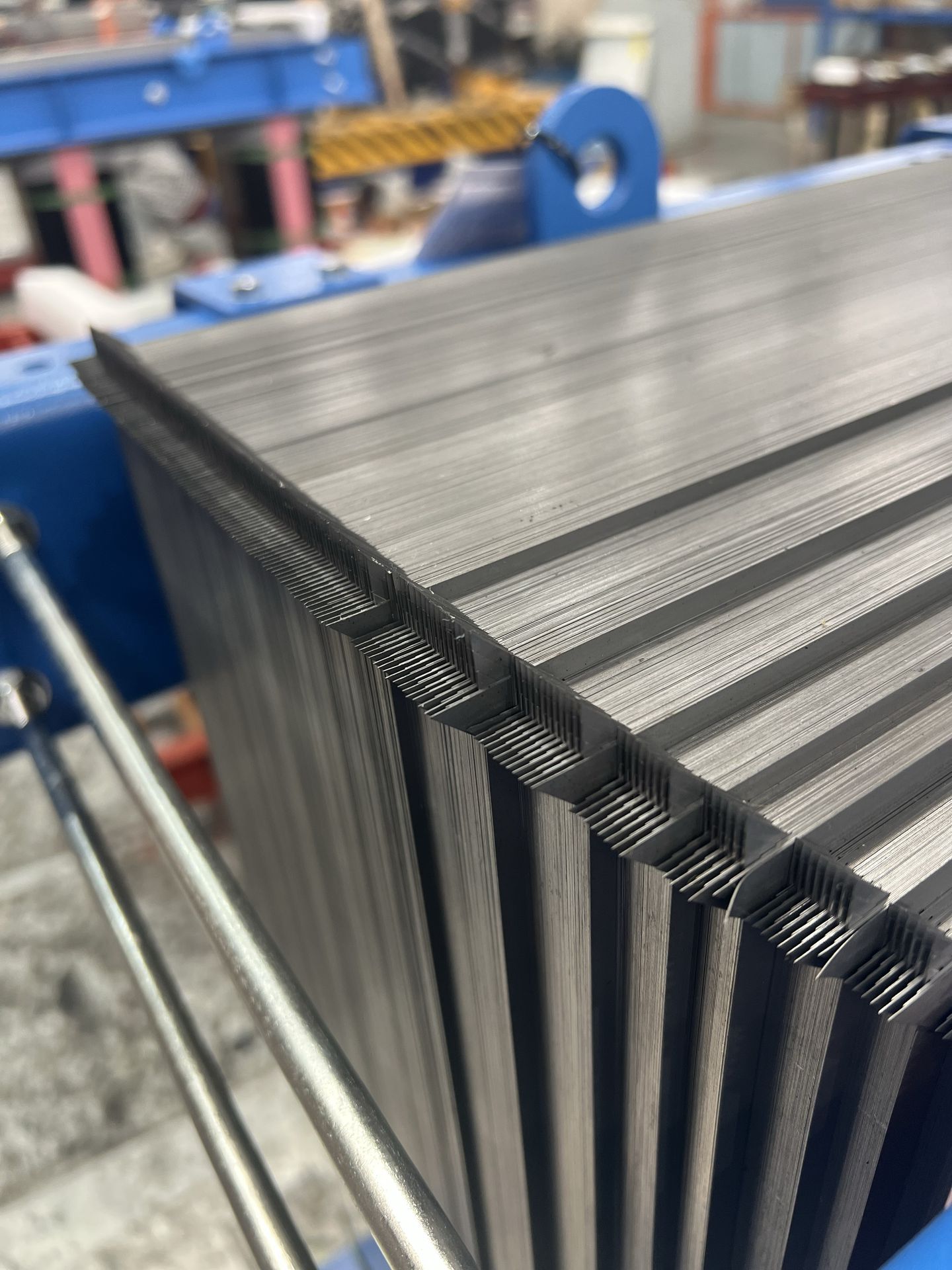
Rectangular laminations are thin sheets of electrical steel, precisely cut and stacked to form the magnetic core of distribution transformers.
Unlike solid metal cores, laminated structures are designed to:
Reduce eddy current losses
Improve magnetic flux control
Enhance thermal dissipation
Increase overall efficiency
Their rectangular geometry allows easy integration into:
E-I core structures
Step-lap core designs
Standardized transformer platforms
Because of their practicality and reliability, rectangular laminations remain the dominant solution in distribution transformer manufacturing worldwide.
3. Why CRGO Steel is Essential
The performance of transformer laminations is fundamentally determined by the properties of CRGO silicon steel.
CRGO material offers:
3.1 High Magnetic Permeability
This allows magnetic flux to pass through the core efficiently, reducing energy loss.
3.2 Low Core Loss
Grain-oriented structure minimizes hysteresis loss and improves efficiency.
3.3 Directional Magnetic Properties
Optimized rolling direction ensures maximum performance when properly aligned.
3.4 Stability Over Long-Term Operation
CRGO maintains performance under continuous operation, making it ideal for transformers with 20–30 year lifespans.
For transformer manufacturers, access to stable and high-quality CRGO material is critical.
4. Engineering Logic Behind Core Efficiency
Transformer efficiency is largely determined by core losses, which include:
4.1 Eddy Current Loss
Generated by circulating currents within the steel core.
Laminations reduce this by:
Increasing electrical resistance between layers
Limiting current loops
4.2 Hysteresis Loss
Caused by repeated magnetization cycles.
CRGO reduces this through:
Controlled grain structure
Domain refinement
4.3 Stacking Factor and Air Gap
Precision in lamination processing affects:
Air gap between sheets
Magnetic resistance
Flux uniformity
Even small imperfections can lead to measurable efficiency loss over time.
5. Challenges Faced by Transformer Manufacturers
In real-world production, transformer manufacturers often encounter several issues related to lamination supply:
5.1 Inconsistent Material Supply
Different batches may vary in:
Thickness
Magnetic properties
Coating quality
5.2 Processing Limitations
Not all suppliers can provide:
High-precision slitting
Low-burr cutting
Customized lamination shapes
5.3 Small Batch and Customization Constraints
Many projects require:
Trial production
Prototype cores
Flexible order quantities
Traditional large-scale mills often struggle to support these needs.
5.4 Supply Chain Complexity
Working with multiple suppliers for:
Raw material
Slitting
Cutting
Assembly
can increase risk and lead time.
6. MOOPEC’s Solution: From Material to Core Components
MOOPEC addresses these challenges by offering an integrated and flexible service model tailored to transformer manufacturers.
Rather than acting solely as a material supplier, MOOPEC provides:
👉 End-to-end CRGO material and processing support
This includes:
Material sourcing from leading mills (Baosteel, etc.)
Slitting and cutting services
Lamination processing
Core component preparation
7. Key Processing Capabilities
7.1 CRGO Slitting Services
MOOPEC provides precision slitting with:
Tight width tolerance
Smooth edge control
Reduced edge damage
This ensures better downstream lamination quality.
7.2 Lamination Processing
Rectangular laminations are processed with focus on:
Dimensional accuracy
Surface protection
Coating integrity
7.3 Low-Burr Cutting Control
Burr height directly affects:
Insulation performance
Core loss
MOOPEC emphasizes controlled cutting processes to minimize burr formation.
7.4 Small-Batch Customization
One of MOOPEC’s key advantages is flexibility:
Low MOQ
Fast sampling
Trial production support
This is especially valuable for:
New transformer designs
R&D projects
Niche applications
7.5 Integrated Supply Model
By combining material and processing, MOOPEC helps customers:
Reduce supplier coordination
Shorten lead time
Improve consistency
8. Application Scenarios and Value
MOOPEC’s CRGO lamination solutions are widely used in:
8.1 Distribution Transformers
Core efficiency and cost balance are critical.
8.2 Industrial Transformers
Higher load conditions require stable performance.
8.3 Renewable Energy Systems
Transformers in solar and wind systems require reliability and efficiency.
8.4 Custom Transformer Projects
Flexible production supports non-standard designs.
9. Industry Trends and Future Requirements
The transformer industry is evolving rapidly due to:
Global energy efficiency regulations
Electrification and EV growth
Renewable energy expansion
Key trends include:
Lower loss CRGO grades
Thinner materials (0.23mm and below)
Higher demand for customization
Faster supply cycles
This shift increases the importance of flexible suppliers like MOOPEC.
10. Key Takeaways
Rectangular laminations remain the backbone of transformer cores
CRGO steel is essential for efficiency and reliability
Processing quality determines real performance
Supply flexibility is becoming a key competitive factor
👉 MOOPEC provides a balanced solution combining:
✔ Material quality
✔ Processing precision
✔ Customization flexibility
11. FAQ
Q1: What does MOOPEC mainly provide?
CRGO material supply, slitting, lamination processing, and core-related solutions.
Q2: Can MOOPEC support small batch orders?
Yes, MOOPEC specializes in flexible and small-batch supply.
Q3: What is the advantage over traditional mills?
More flexibility, faster response, and integrated processing services.
Q4: What industries use these laminations?
Power distribution, industrial transformers, renewable energy systems.
Q5: How does lamination quality affect transformer performance?
It directly impacts core loss, heat generation, and lifespan.



