Cold Rolled Steel
Cold-rolled steel sheet is a metal sheet that is cold-rolled to hot-rolled billets at room temperature to improve surface quality,dimensional accuracy and mechanical properties. It is commonly used in automobiles,home appliances and construction.
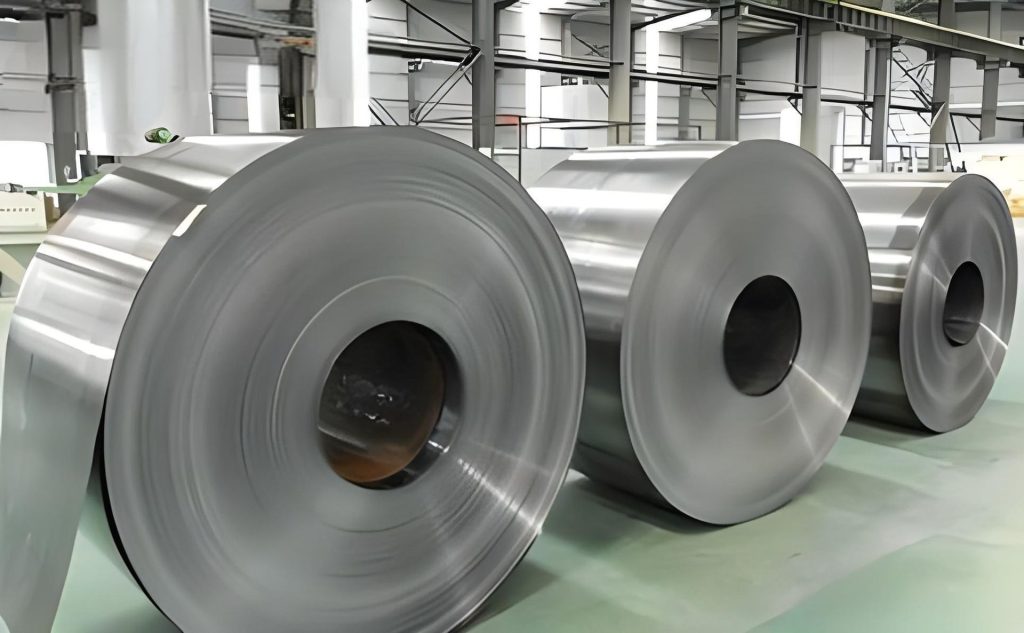
Duplex Cold Rolled Steel
Duplex steel has the characteristics of austenite and ferrite stainless steel, higher plasticity and toughness, no room temperature brittleness, intergranular corrosion resistance and welding performance are significantly improved.
| Grade | Chemical Componenta % | ||||
| C | Si | Mn | P | S | |
| HC250/450DP | ≤0.15 | ≤0.6 | ≤2.5 | ≤0.040 | ≤0.015 |
| HC290/490DP | ≤0.15 | ≤0.6 | ≤2.5 | ≤0.040 | ≤0.015 |
| HC340/590DP | ≤0.15 | ≤0.9 | ≤2.5 | ≤0.040 | ≤0.015 |
| B340/590DP | ≤0.18 | ≤0.9 | ≤2.5 | ≤0.040 | ≤0.015 |
| HC420/780DP | ≤0.18 | ≤0.9 | ≤2.5 | ≤0.040 | ≤0.015 |
| HC500/780DP | ≤0.18 | ≤0.9 | ≤2.5 | ≤0.040 | ≤0.015 |
| B420/780DP | ≤0.23 | ≤0.9 | ≤2.5 | ≤0.040 | ≤0.015 |
| HC550/980DP | ≤0.23 | ≤1.0 | ≤3.0 | ≤0.040 | ≤0.015 |
| HC650/980DP | ≤0.23 | ≤1.0 | ≤3.0 | ≤0.040 | ≤0.015 |
| HC700/980DP | ≤0.23 | ≤1.0 | ≤3.0 | ≤0.040 | ≤0.015 |
| HC820/1180DP | ≤0.23 | ≤1.0 | ≤3.0 | ≤0.040 | ≤0.015 |
| HC950/1310DP | ≤0.23 | ≤1.0 | ≤3.0 | ≤0.040 | ≤0.015 |
| HC1000/1470DP | ≤0.28 | ≤1.0 | ≤3.0 | ≤0.040 | ≤0.015 |
a. Al, Nb, Ti, Cr, Mo, B and other alloying elements can be added as required, and the total amount of these alloying elements is not more than 1.5% at this time.
| Grade |
YS Strength (MPa) |
Tensile Strength (MPa) |
Elongation A50mm % |
nb |
| HC250/450DP | 250~320 | ≥450 | ≥28 | ≥0.16 |
| HC290/490DP | 290~390 | ≥450 | ≥26 | ≥0.15 |
| HC340/590DP | 340~440 | ≥590 | ≥22 | ≥0.14 |
| HC420/780DP | 420~550 | ≥780 | ≥15 | – |
| HC500/780DP | 500~650 | ≥780 | ≥12 | – |
| HC550/980DP | 550~720 | ≥980 | ≥9 | – |
| HC650/980DP | 650~900 | ≥980 | ≥8 | – |
| HC700/980DP | 700~920 | ≥980 | ≥8 | – |
| HC820/1180DP | 820~1150 | ≥1180 | ≥5 | – |
| HC950/1310DP | 950~1250 | ≥1310 | ≥5 | – |
| HC1000/1470DP | 1000~1300 | ≥1470 | ≥5 | – |
a. When the yield phenomenon is not obvious, Rp0.2 is used; otherwise, ReL is used.
b. The sample is P17 as specified in GB/T 228.1, and the direction of the sample is transverse. If the user has special requirements can be negotiated to determine.
c. When the nominal thickness of the product is greater than 0.50mm, but less than or equal to 0.70mm, the elongation after breaking is allowed to decrease by 1%.
| Grade | YS Strength(MPa) | Tensile Strength (MPa) | Elongation A50mm % |
180° Bending Test Dia≥ (a=sample thickness) |
||
| Thickness mm | ||||||
| <1.0 | 1.0~1.6 | ≥1.6 | ||||
| B340/590DP | 340~500 | ≥590 | 16 | 18 | 20 | 2a |
| B420/780DP | 420~590 | ≥780 | – | 14 | 16 | 6a |
a. RP0.2 is used when the yield phenomenon is not obvious, and ReL is used.
b. The sample is P17 as specified in GB/T 228.1, and the direction of the sample is transverse. If the user has special requirements can be negotiated to determine.
c. The specified value of the bending test is applicable to the transverse specimen, the width of the bending specimen b≥35mm. The sample width during the arbitration test was 35mm. If the supplier can guarantee it, it may not carry out bending test.